Erawan Falls, Kanchanaburi: What to Expect on the Seven-Tier Hike
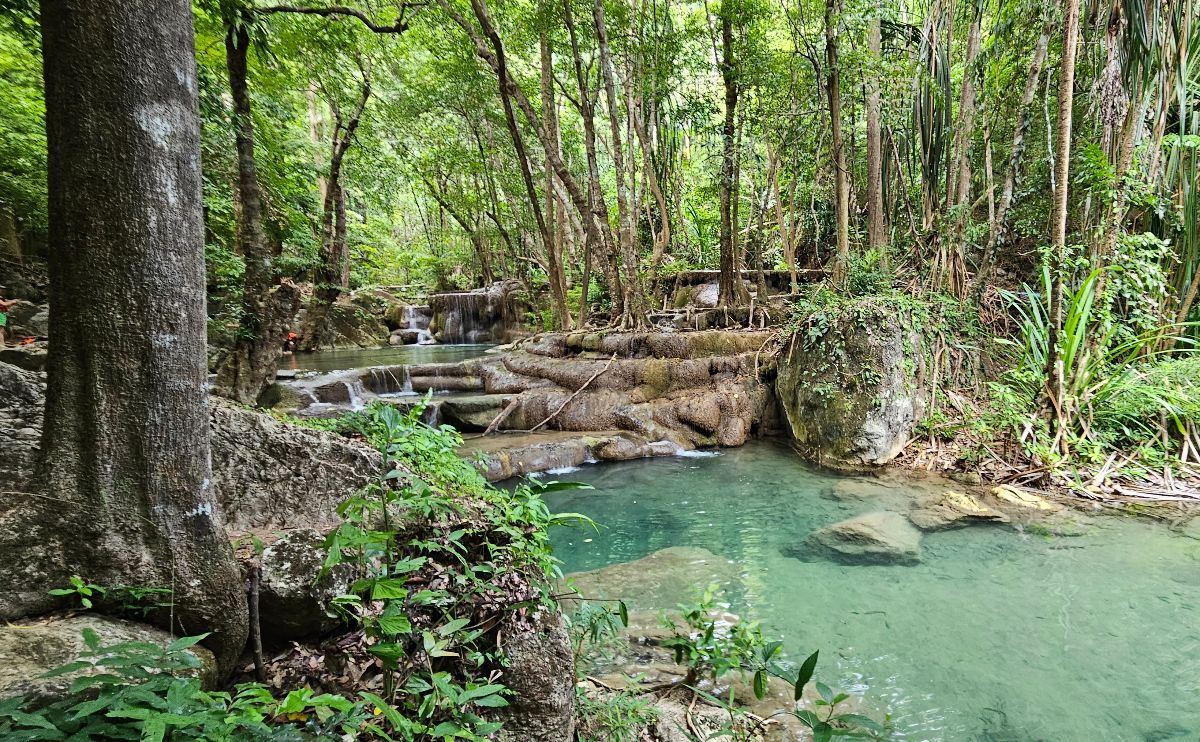
Erawan Falls in Kanchanaburi Province has seven tiers of waterfalls, each with its own pool to swim in. We spent an extended visit in Kanchanaburi last year and it’s become our favourite getaway from Bangkok. Below is everything you need: how to get there, when to go, what to expect on the hike, and where to stay.
Erawan Falls at a Glance
Location: Erawan National Park, Kanchanaburi Province
Tiers: 7 waterfalls across 2,000 metres of trail
Entry fee: 300 Baht adults, 150 Baht children (3–14 years)
Opening hours: 8am–4.30pm daily (upper tiers close from around 3pm)
Closed: Often closed for periods during September, due to heavy rainfall
Hike time: 1.5–2 hours walking only, half a day realistic with stops
Difficulty: Easy at tiers 1–2, moderate at tiers 3–4, steep and uneven at tiers 5–7
Swimming: Allowed at most tiers; lifejacket rental required (20 Baht)
Food: Not permitted beyond tier 2; drink bottles need a declared deposit
This page contains affiliate links. Please see our disclosure policy for more details.
What Are Erawan Falls and Are They Worth Visiting?
Yes, Erawan Falls are absolutely worth it. Located in Erawan National Park in Kanchanaburi Province, the seven-tiered waterfall stretches 2,000 metres from base to top, with emerald green pools at every level. It’s one of Thailand’s most scenic day hikes, and after doing the full walk, it’s become one of our favourite places in the country.
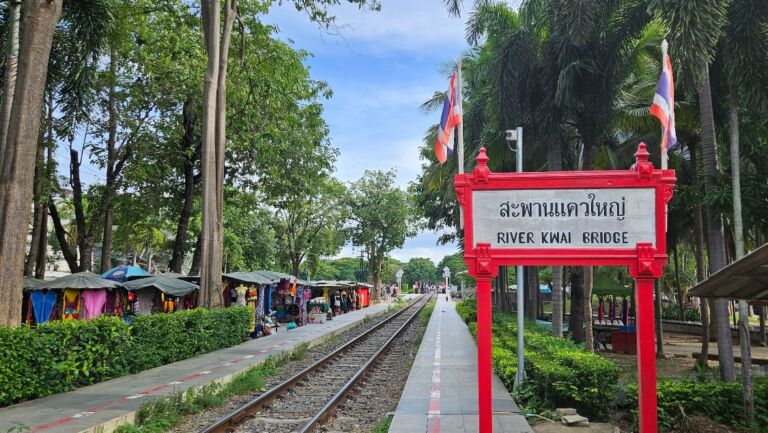
Best known for the ‘bridge over the River Kwai’ and its involvement in World War II, Kanchanaburi draws many visitors to its war memorials and museums.
Kanchanaburi, also has some interesting temples, but the top reason many local and international tourists head there is for the waterfalls and forest scenery.
One of my favourite places to visit in Kanchanaburi is Erawan Falls. Here’s my complete guide from how to get there to what to see.
What makes Erawan Falls special?
Erawan National Park in Kanchanaburi Province is Thailand’s 12th national park, founded in June 1975. There are several reasons to visit the national park, but the major attraction is Erawan Falls.
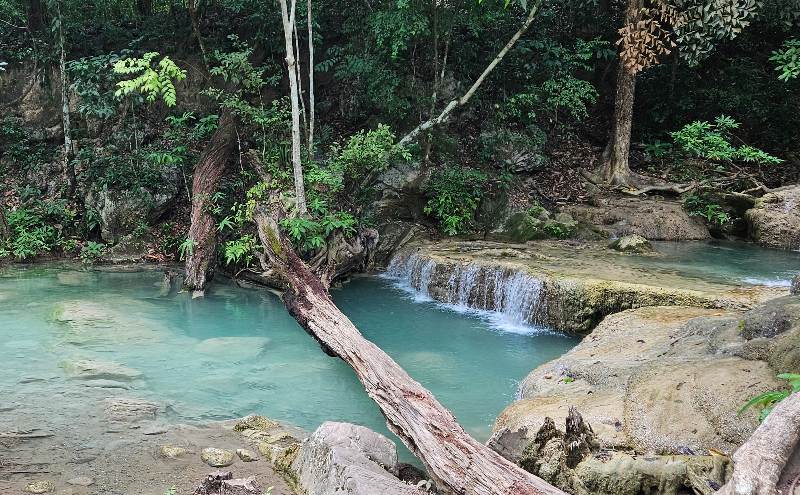
The 7-tiered falls give you a reason to keep walking, each tier looks different from the last, culminating in the 7th level, the waterfall that resembles the 3-headed Erawan elephant from Hindu mythology.
It’s 1,500 meters from the top to the bottom and takes a couple of hours to get there, so be prepared for a half day of trekking.
Along with being just gorgeous to look at these are falls, you are encouraged to swim in. In fact, in many levels, you can get right up underneath the various falls. Little effort is required to walk to or swim in the lower levels, making the falls suitable for most visitors, including families and those with limited mobility.
What to Expect when you Hike the falls
My advice is to take your time, enjoy all the sights and sounds, and rest at each tier. There’s no need to rush it. However, if you arrive early I think it’s worth doing a quick hike to level 3 so you can enjoy it without the crowds.
Here’s a look at what you can see and do at each of the seven tiers.
Tier 1 – Lai Khuen Rang
This is your entry tier; it’s like a long stream with a drop at the end. Many people prefer to stay here, swim in the shallow pools and picnic by the side of this stream. It’s a promise of what’s to come.

If you are travelling with small kids or if you have any mobility problems, there is wheelchair access to a section of this tier.
Tier 2 – Wang Mat Cha
This is your first achievement; it’s a pretty blue pool, and a few different varieties of fish inhabit it. Feel free to swim here, although more beautiful sites await you.
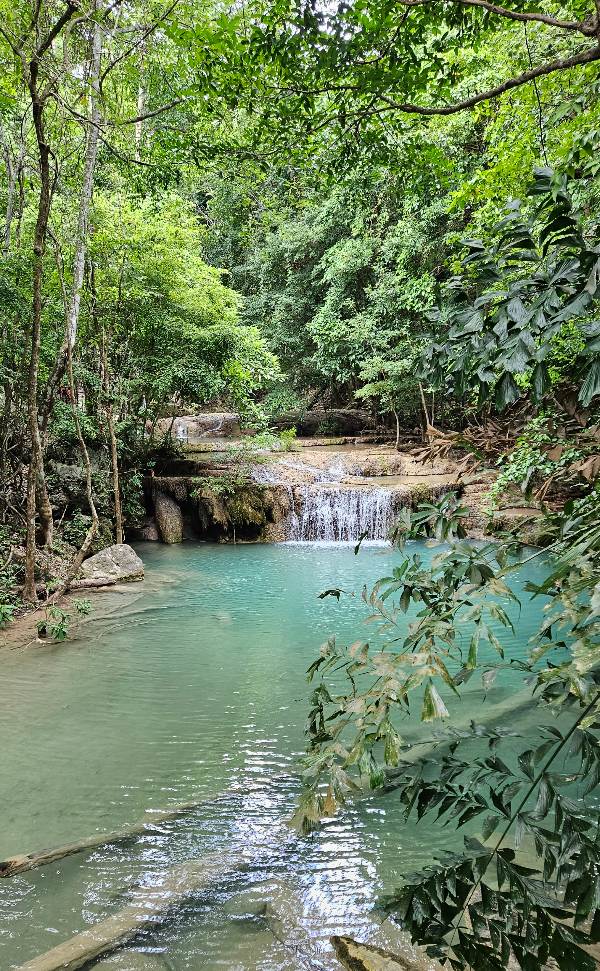
Resist the urge to stop here for too long and keep moving, the next level is usually deeper and better for swimming.
Tier 3 – Pha Nam Tok
Don’t blink, or you’ll miss the turnoff to level 3. It’s just off the main path, but a sign shows the way. You don’t want to miss Pha Nam Tok, the largest waterfall on the seven tiers.
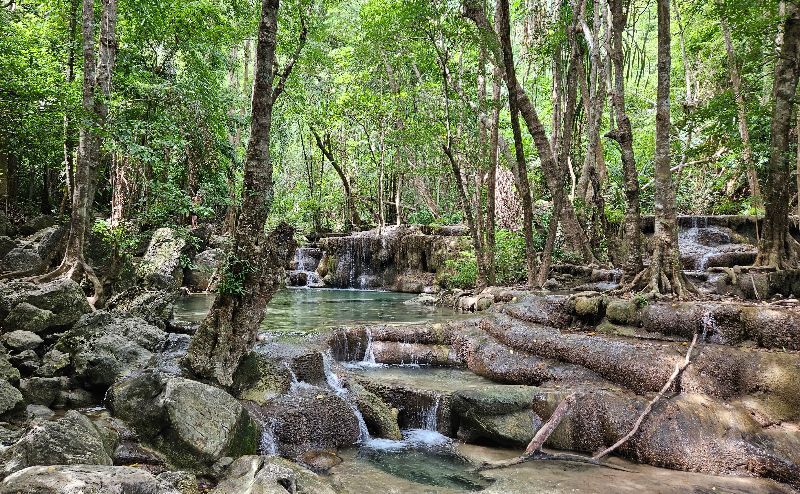
The pool is enormous, and it can get very crowded during the high season, which is a shame, but if you get here early you can have a pool to yourself. We entered as the park opened and there were only a couple of other people here.
Tier 4 – Oke Nang Phee Suae
This waterfall flows over some boulders into a big pool with loads of fish. The pond isn’t the easiest to get to as you have to climb over some boulders to get into it.
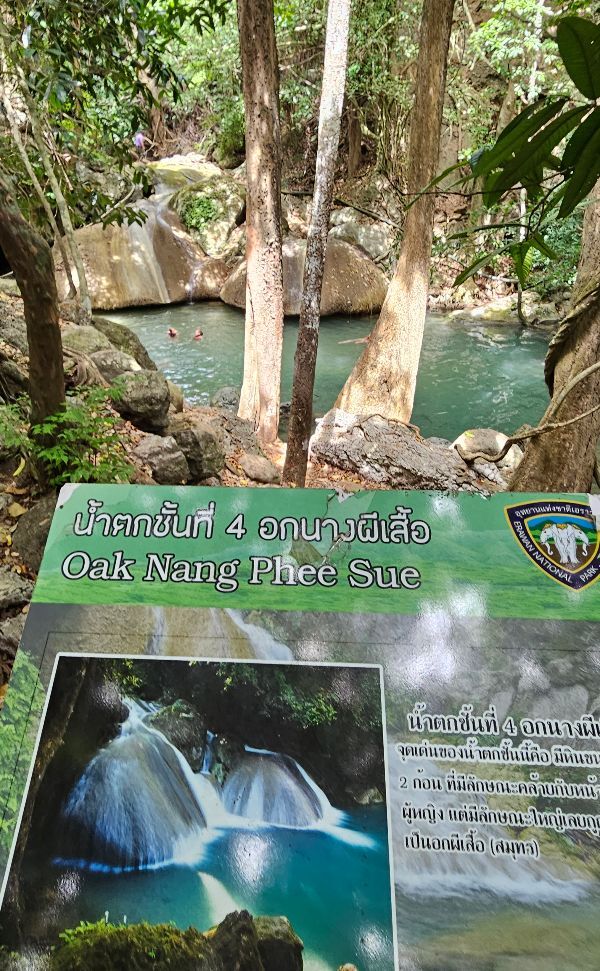
Don’t worry about the fish; they don’t seem to care that you’re there so you can enjoy the cool water. On our visit in July, there was not a lot of water in the falls and they had set up a pipe to bring water up.
Tier 5 – Buar Mai Long
By the time I got to tier 5, I was ready to rest. There wasn’t a great swimming area here, but the nature is beautiful, and it’s an excellent place to prepare yourself for what’s to come.

If you have found the walk to this point has become a bit challenging, I suggest you stop here. It only gets harder. In hindsight, I wish I had stopped here! The next section of the hike is harder, but it was actually walking back down the hill that was my undoing.
Tier 6 – Dong Pruk Sa
Dong Pruk Sa is beautiful, and there’s a viewing platform just off the main track. There’s a tiny swimming area, but I didn’t see many people using it.

Tier 7 – Phu Pha Erawan
The final and the best drop is supposed to be Phu Pha Erawan, the 3-headed elephant waterfall. I have to be honest; I didn’t see the elephant.
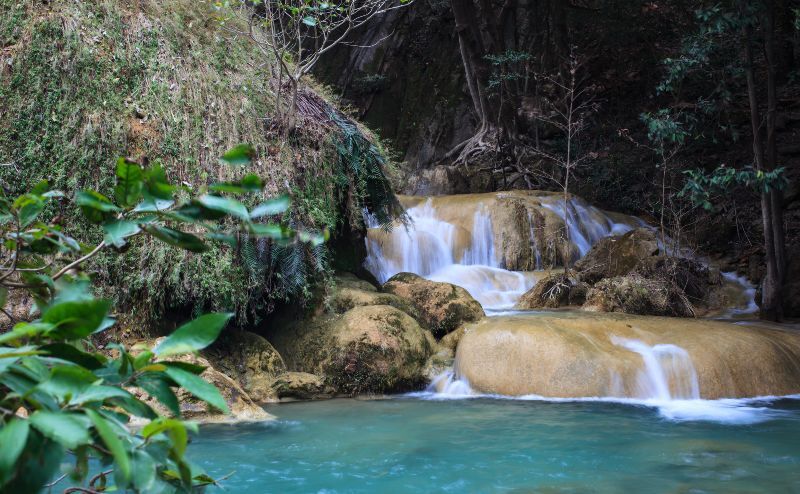
However this top tier sight to behold, and you’ll definitely want to cool off in the pool, especially if you haven’t done it at any of the other tiers.
Erawan Falls Difficulty by Tier
Your footwear and fitness level matter more than time here, this breakdown shows where the trail gets steep so you can decide how far to go.
|
Tier |
Difficulty |
What to Expect |
|---|---|---|
|
1 |
Easy |
Flat entry stream with shallow pools. Wheelchair access to part of this tier. |
|
2 |
Easy |
Short walk to a blue pool with fish. Good swimming, but better tiers are ahead. |
|
3 |
Moderate |
Turnoff is easy to miss. Largest pool on the trail, but it gets crowded in high season. |
|
4 |
Moderate |
Requires climbing over boulders to reach the pool. Deep swimming hole with fish. |
|
5 |
Challenging |
Limited swimming area. If the walk feels hard by this point, this is the spot to stop. |
|
6 |
Challenging |
Viewing platform just off the main track. Small swimming area, rarely used. |
|
7 |
Challenging |
Final tier with a rewarding pool. Steep stairs make the walk down riskier than the climb up. |
I was so proud of myself for making it to the top that I rushed back down not being particularly careful, and twisted my knee. It was a long way back to the bottom!
How to Prepare for the Walk & what to wear
You’re going to be walking on a forest track and it’s very humid, so wear light material that breathes, no sweaters needed.
Hiking boots aren’t necessary, you could wear sturdy hiking sandals as your feet will get wet. Whatever you wear make sure it has decent non-slip traction. I wore waterproof hiking shoes as I felt more stable in them. Plenty of people were wearing regular sneakers and even crocs and they seemed fine!
Also, be prepared for lots of rules. The park management is very strict about safety and there is a large lifejacket rental desk before you head off to level 2.
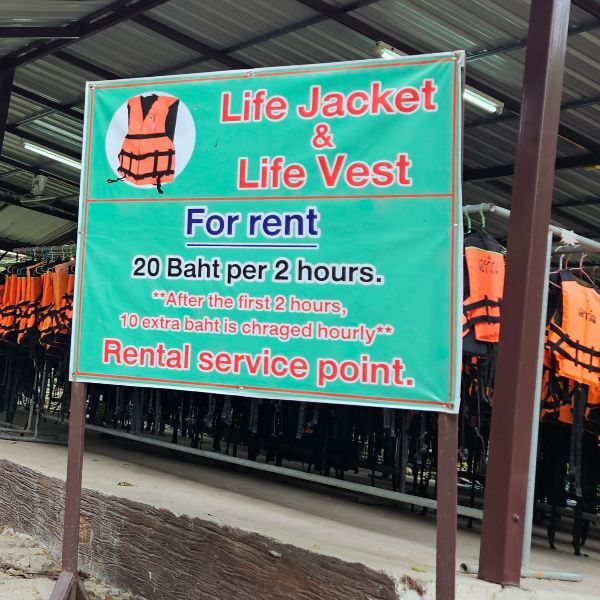
All who plan to swim are supposed to rent a lifejacket. We saw plenty of people ignoring this rule. Rental is 20 Baht.
Environmental protection is also a top priority. To curb plastic rubbish in the waterfalls, you may not take food beyond level 2.
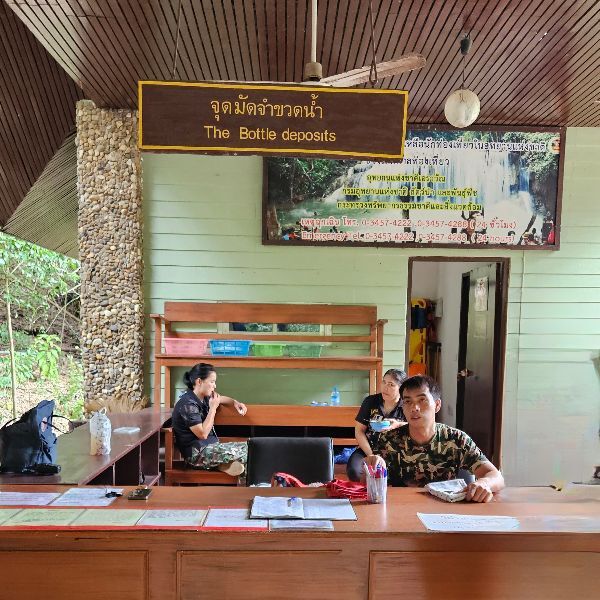
You can take drink bottles but these must be declared, and a deposit paid before you continue to level 3. When you return your bottle the deposit is refunded.
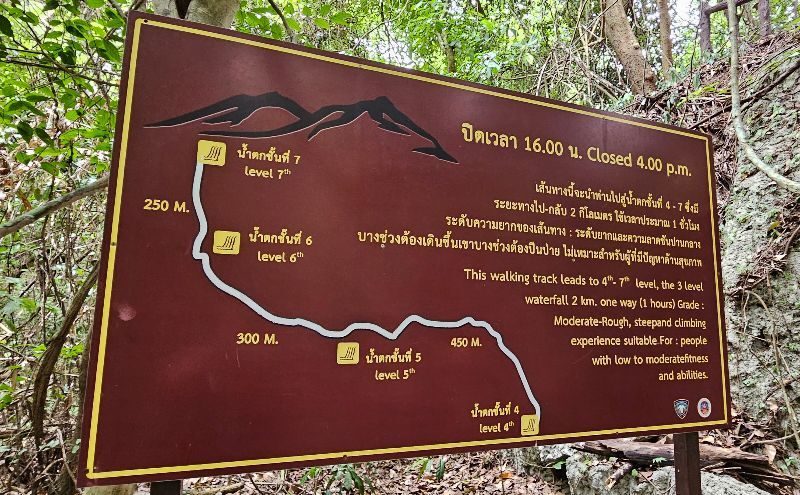
Even though it’s only 1,500 meters from bottom to top, remember you’re steadily going up. I didn’t count the stairs, but there were a lot! Particularly when you get past level 5.
It will take an average person 1.5 to 2 hours. You’ll want to stop at each tier, look around, and take some photos before proceeding. Allow more time if you plan to swim.
Always look where you’re going, and go slow; the elements erode some slatted stairs, so tread carefully. I slipped on my way down and it was not fun!
What to Do If You Can Only Spare Half a Day
Yes, half a day is enough to make it worthwhile. We did it in three hours, reaching tier 7 and back, but it didn’t leave much room to relax, just a quick swim before heading straight to the car. Looking back, we’d stop at tier 5 instead. You still get the full range of the hike, easy to challenging, without rushing the walk down, which is where most of the tricky footing is. If you want a swim with fewer crowds, save it for tier 3 on the way back down.
Planning your Visit to Erawan Falls
It’s worth a bit of planning before you set out. On our first attempt to visit in 2022, we discovered the day before we were due to leave Bangkok that the waterfalls were closed because of flooding. On the other hand, visit in the dry season and the falls won’t look their best!
Best Time of Year to Go to Erawan Falls
Erawan National Park is open for 11 months of the year. The park is sometimes closed for the periods in September because of heavy rainfall. If you have some flexibility about when you visit, it’s a good idea to choose a time with decent rainfall so you can see the falls at their best.
I think the best time to visit Erawan Falls is May-June or after the rainy season in November.
Thailand has three seasons:
- Summer: from February to April, it can get very hot and humid during this time, and climbing to the higher levels of the waterfall can be challenging.
- Rainy: from May to October, storms can come from the southwest, however, the hills protect the park from the monsoon so it doesn’t see as much rainfall as other areas. It can still be slippery and slightly dangerous on days with rain.
- Winter: November to January are the cooler months when temperatures drop to around 20° in the evening but remain around 30° during the day.
Kanchanaburi Rainfall and Average temperatures
| Month | Avg High Temp | Avg Low Temp | Avg Rainfall (mm) |
|---|---|---|---|
| January | 34.0°C / 93.2°F | 19.0°C / 66.2°F | 5 |
| February | 35.5°C / 95.9°F | 21.2°C / 70.2°F | 30 |
| March | 37.2°C / 99.0°F | 23.5°C / 74.3°F | 29 |
| April | 38.4°C / 101.1°F | 25.6°C / 78.1°F | 65 |
| May | 35.6°C / 96.1°F | 25.2°C / 77.4°F | 220 |
| June | 33.9°C / 93.0°F | 24.5°C / 76.1°F | 155 |
| July | 33.6°C / 92.5°F | 24.3°C / 75.7°F | 175 |
| August | 33.5°C / 92.3°F | 24.2°C / 75.6°F | 197 |
| September | 33.1°C / 91.6°F | 24.0°C / 75.2°F | 344 |
| October | 32.9°C / 91.2°F | 23.5°C / 74.3°F | 242 |
| November | 33.2°C / 91.8°F | 22.2°C / 72.0°F | 48 |
| December | 32.5°C / 90.5°F | 19.8°C / 67.6°F | 10 |
If you can visit midweek, it is less crowded. And if you are here during Songkran be ready for some serious water fights!
How to Get To Erawan Falls From KanchanaburI
Erawan Falls is 70km from the centre of Kanchanaburi. Thankfully, there is a minibus service for those of you who prefer not to drive in Thailand.
By car – You can get to Erawan waterfall from downtown Kanchanaburi in around an hour; it’s 70 kilometres. Take Highway no. 3199 to the Electricity Generating Authority of Thailand at Sirindhorn Dam, then cross the bridge, drive past the market, and you’ll see Erawan National Park.
By bus from Kanchanaburi to Erawan Falls– take minibus no 8170 from Kanchanaburi bus station. It leaves every hour from 8.00 – 17.20 and takes 1 and 1/2 hours to get to the Erawan National Park.
From Nam Tok to Erawan Falls – If you are planning on visiting the war memorial at Hellfire Pass on the same day, I would recommend you start at Erawan Falls as soon as it opens then visit Hell Fire Pass after lunch. You will need private transport to do this. The trip is about 50km and the drive will take just under an hour.
See our full guide to the best ways to travel from Bangkok to Kanchanaburi.
How to get to Erawan Falls from Bangkok
Getting to Erawan Falls from Bangkok takes a few steps, here’s how it breaks down.
First, catch a bus from Bangkok’s Southern Bus Terminal to Kanchanaburi. The journey usually takes around 3-4 hours, depending on traffic.
Once in Kanchanaburi, you would need to catch the local bus number 8170 from Kanchanaburi Bus Terminal to Erawan National park. They depart every hour from 8 am to 5 pm. This leg of your journey will take about another 2 hours.
Alternatively, if you prefer a more direct and less time-consuming route, you can hire a private car or taxi from Bangkok. You can find a driver on Grab but we used InDrive.
Tip: To make your journey as smooth as possible, ensure you carry enough Thai Baht to cover your transportation expenses, as credit cards are not commonly used for these.
Where to stay near Erawan Falls
If the falls are your main focus and you’re visiting on a weekend or Thai holiday, stay near the park. The crowd difference between 9 a.m. and 11 a.m. is massive. If you’re doing a broader Kanchanaburi trip and visiting midweek, town works fine—just arrange transport the night before so you’re not wasting morning hours figuring out songthaews.
Erawan National Park has a campsite, and basic bungalows. Hotels and homestays are all along the 3199 road into Erawan to suit every budget.
We stayed in town at Natee The Riverfront Hotel in Kanchanaburi and drove to the falls early in the morning.
Z9 Resort
Just 22km from Erawan Falls Z9 Resort is the most upscale option near the park. These 50-square-meter pods sit right on the river with a private terrace — perfect if you want to wake up to the sound of water and spend a full day exploring without rushing back to town. The onsite restaurant is a real bonus this far from anywhere else.
Check photos and prices of Z9 Resort
Taramontra Resort
Taramontra Resort sits just 8km from the falls, close enough to beat the crowds if you leave at sunrise. The floating cabins come with free kayaks and a SUP, and it’s one of the few spots this close to the park that’s reachable by the local bus from Kanchanaburi — a solid pick if you’re not renting a car.
Check photos and prices of Taramontra Resort
As it’s only an hour away from central Kanchanaburi, you could have your base there and make a day out of it. If you’re looking for something luxurious, Cross River Kwai is one of our favourites.
Spend at least half a day at Erawan Falls
If you’re in Kanchanaburi for a few days, spend at least one of them at Erawan Falls. It’s one of the better waterfall hikes in Thailand, and if you’re prepared to walk to the top, the waterfall that looks like three elephant heads is well worth it.
In fact, if you have a few days, I’d stay on the river and dedicate a full day to the park. Beyond the main waterfall trail, Erawan National Park has two limestone caves worth exploring if you have extra time: Phra That Cave and Ta Duang Cave. Both have small swimming areas inside, and because most visitors stick to the waterfall tiers, you’ll likely have them almost to yourself.
Ask at the ranger station near the park entrance for directions — they’re a bit off the main path, so it helps to get a map or a quick orientation before heading out. Bring a headlamp if you have one, the caves are dimly lit.
Key Takeaways
- Seven tiers across 2,000 metres of trail, from easy at the bottom to steep and uneven by tier 5
- Foreigner entry costs 300 Baht for adults, 150 Baht for children aged 3-14.
- Open 8am to 4.30pm daily; upper tiers close from around 3pm
- Closed for all of September due to heavy rainfall
- Half a day is enough if you stop at tier 5, save swimming for tier 3 on the way down
- Swimming is allowed at most tiers, but you’ll need a lifejacket (20 Baht rental)
- No food permitted beyond tier 2; drink bottles need a declared deposit
- Footwear with good grip matters more than hiking boots, your feet will get wet regardless
Planning a Thai adventure? Join our friendly Facebook community Thailand Awaits: Trip Planning for Beginners. Get expert advice from locals and experienced travellers, ask your questions, and discover how to make the most of your journey through Thailand.