Thai Etiquette: What First-Timers Need to Know (And What regulars Still Get Wrong)
Thailand is one of the more forgiving countries for foreign visitors. Thais are generally patient with people who are clearly trying, and a genuine attempt to follow local customs goes a long way even when you get it wrong.
That said, there are mistakes that go beyond embarrassing — ones that can cause real offence, damage a business relationship, or in some cases, have legal consequences. After twenty years of visiting and two years of living here, I’ve seen most of them firsthand.
This guide covers the basics for first-timers, but it also goes into some of the subtler territory that catches out people who’ve been here long enough to think they know the rules. There’s usually another layer.
The Wai
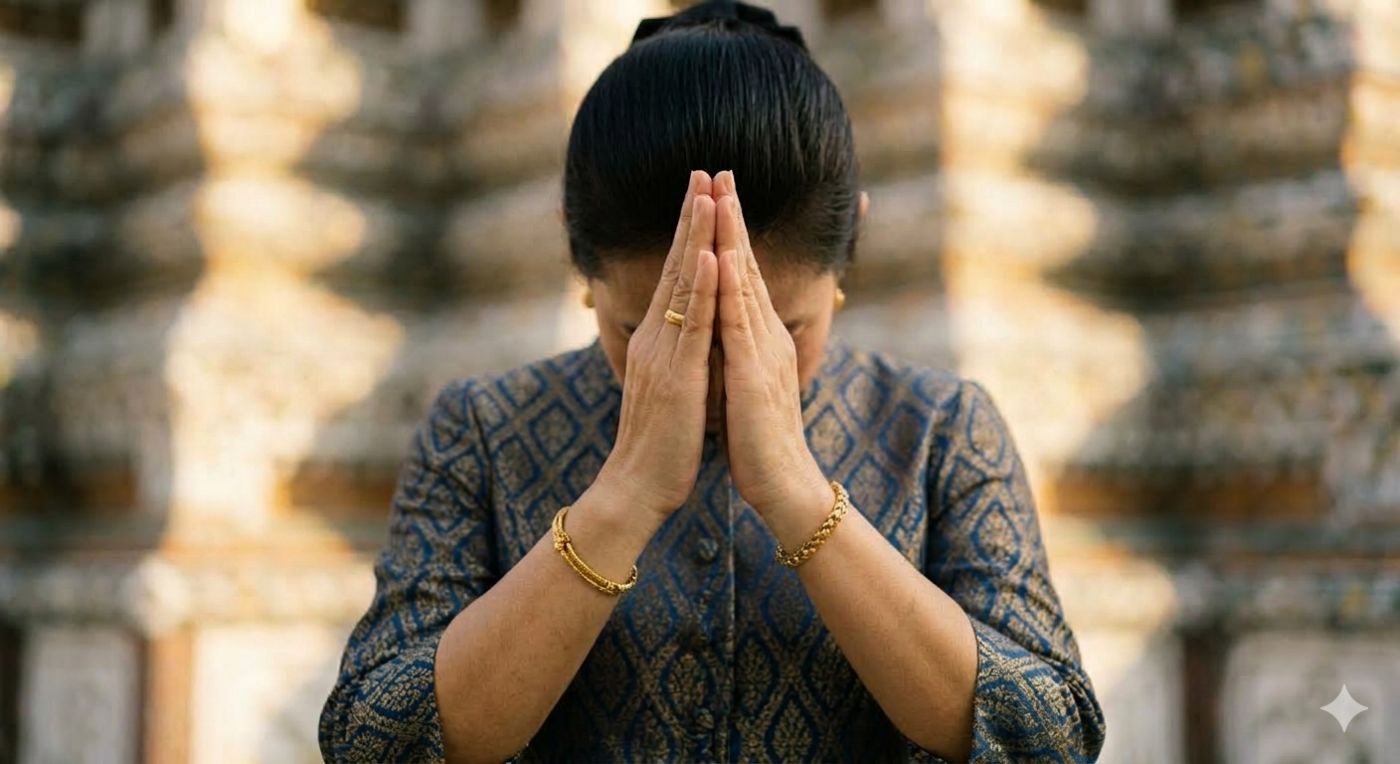
The wai — hands pressed together at chest height, slight bow of the head — is how Thais greet, say goodbye, and express thanks. As a foreigner, you’re not expected to initiate it, but returning one is basic courtesy. If someone wais you, wai back.
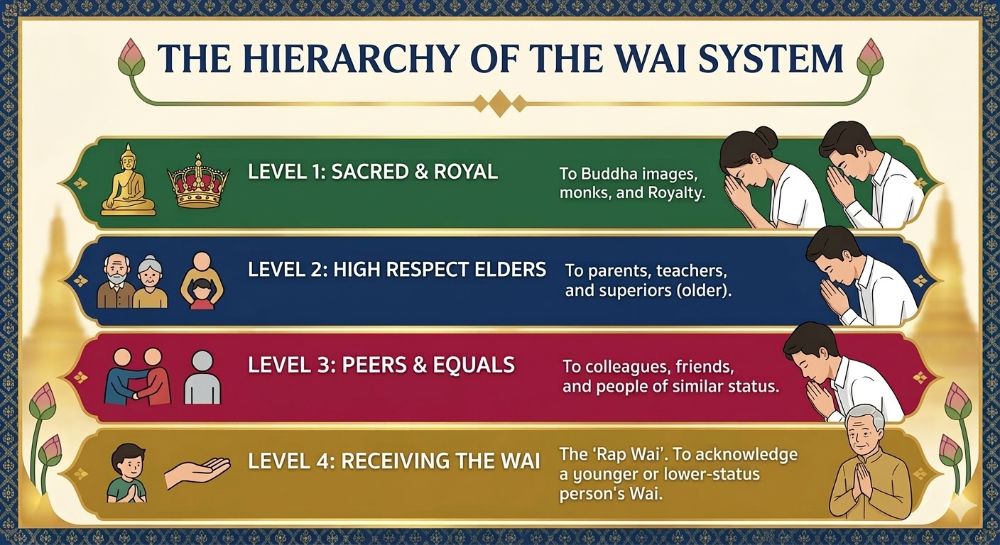
Where it gets more interesting is the hierarchy. The depth of the wai and where you hold your hands signals relative status — the higher the hands and the deeper the bow, the greater the respect being shown. You’ll notice this if you watch Thais interacting with each other. A junior employee greeting a senior one looks different from two peers saying hello.
If you wai a monk, hands go high — close to the face — with a pronounced bow. He won’t wai back, and that’s not a slight. Monks sit at the top of the social hierarchy and a blessing in return is more than sufficient.
For tourists, the main thing is don’t overthink it. Mirror what you’re given, keep it natural, and you won’t go wrong.
For expats, the social calibration matters more. Over-waiing people who aren’t expecting it — a cashier, a street vendor — can come across as odd or even slightly mocking, though it’s never meant that way. And in a workplace or formal setting, getting the hierarchy wrong reads more clearly than you’d expect.
One practical note: you don’t wai children, and you don’t wai while holding things. If your hands are full, a nod and a smile is fine.
Shoes Off / Head and Feet
Removing your shoes before entering a home is non-negotiable. You’ll also need to take them off at temples, and occasionally at small guesthouses, local restaurants, and shops — follow the lead of whoever is ahead of you, or look for the pile of shoes at the door.
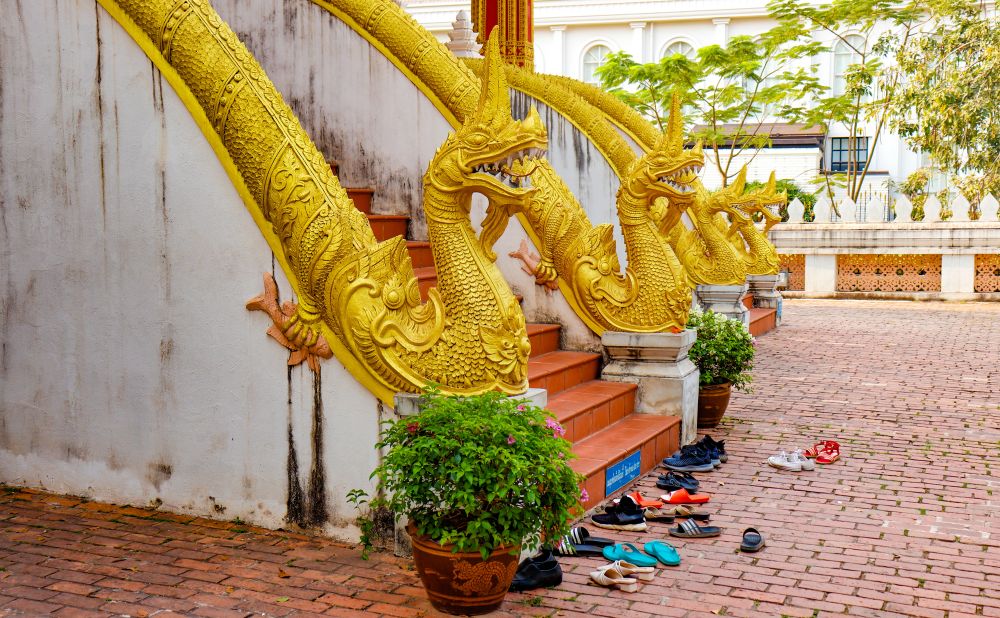
The practical upside of this: wear shoes you can slip on and off easily. Laces are a minor irritation that become a real one when you’re removing your shoes for the fifth time in a day at a busy temple complex.
The underlying logic connects to something broader in Thai culture — the hierarchy of the body. The head is the most sacred part, the feet the lowest. This isn’t abstract; it shapes everyday behaviour in ways that catch people out.
Don’t touch anyone’s head, even affectionately. This applies to children too, which surprises a lot of visitors who are used to ruffling a kid’s hair as a friendly gesture. It doesn’t land the same way here.
Feet carry the opposite weight. Don’t point your feet at people, at Buddha images, or at monks. Sitting cross-legged in a temple is fine; stretching your legs out so your feet point toward the altar is not. In someone’s home, be aware of how you’re sitting.
The feet rule extends to everyday situations in ways that aren’t always obvious. Propping your feet up on a chair or table, or moving something with your foot rather than your hand, is considered careless at best.
Temple Dress and Behaviour
The rule most visitors know is cover your shoulders and knees. That’s correct, and most major temples will turn you away or rent you a sarong if you don’t.
What’s less obvious is that the standard applies to men as well as women — a bare-chested man wandering a temple complex is as out of place as someone in a crop top, and away from the beach or your resort, bare chests generally aren’t appropriate anywhere. Our Bangkok temple guide covers what to expect at specific sites.
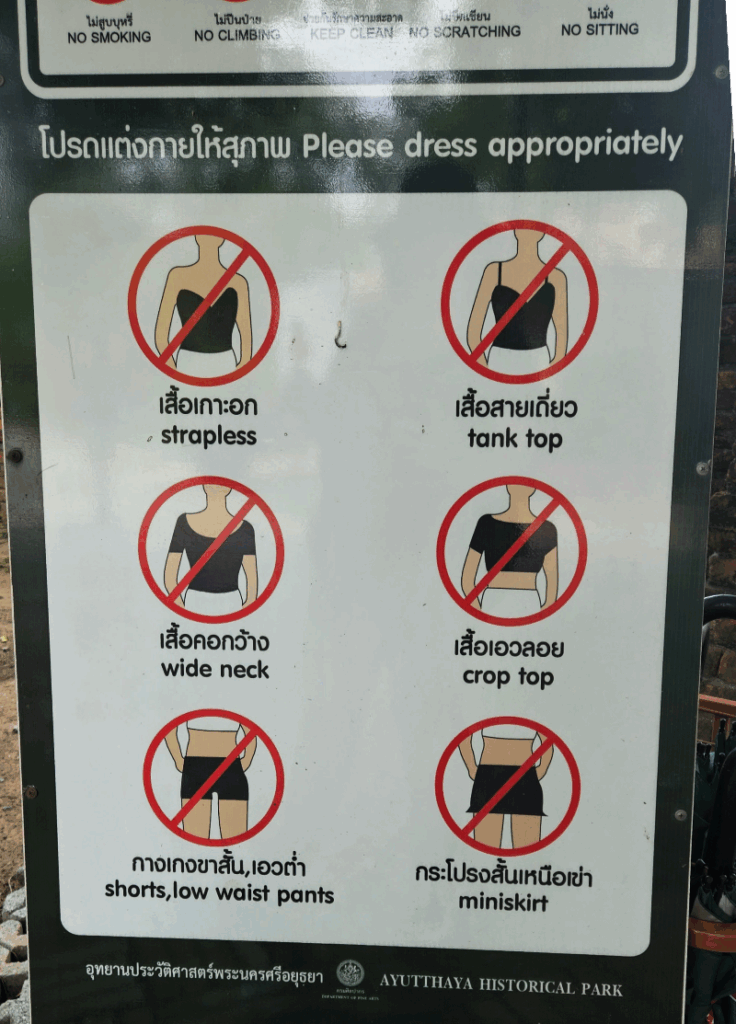
Dress practically. If you’re planning a day that includes temples, wear or carry something you can add or remove easily. Loose trousers and a light shirt solve the problem without making you sweat more than necessary.
When you enter temple buildings step over the threshold rather than on it — it’s a habit worth forming quickly as it applies across temples and traditional buildings throughout the country.
Treat Buddha images with straightforward respect. Don’t climb on them, don’t pose with them for photos, and don’t turn your back to them to take a selfie. This seems obvious written down but it happens constantly.
Monks
Thailand has around 300,000 monks, and in most parts of the country you’ll encounter them regularly — at temples, on public transport, at markets in the early morning. The basic rules are straightforward: show respect, don’t touch, and if you’re a woman, maintain physical distance.
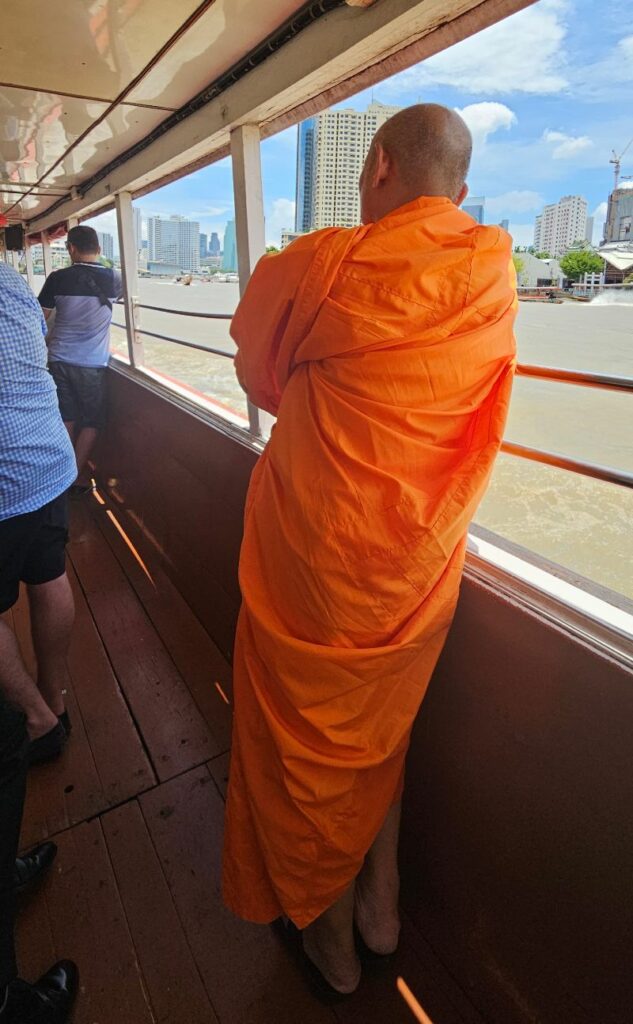
The no-contact rule for women is firm. A female passenger on the BTS who accidentally brushes against a monk requires a purification ritual on his part. If you need to hand something to a monk and you’re a woman, place it within reach rather than handing it directly. If you’re a man, you can hand things directly.
My first close encounter with this was on a songthaew in Hua Hin — the only seat left was next to a monk. Before I’d worked out what to do, another passenger, a man, quietly got up and swapped sides so he was sitting next to the monk instead of me. Nobody said a word about it.
The morning alms round — merit-making, or tak bat — happens in most towns and cities before 8am. Monks walk a set route and lay people offer food.
If you want to observe, keep a respectful distance and stay quiet. If you want to participate, buy prepared offerings from nearby vendors rather than improvising. Don’t treat it as a photo opportunity. If you’re planning a temple visit in Bangkok, our Bangkok temple tour guide covers the main sites and what to expect at each.
When sitting near a monk — in a temple or on transport — try to position yourself lower than him if possible. Wai when you greet one, hands high and close to the face as covered in the wai section.
Dining
Thai food is eaten with a spoon and fork — the spoon in your right hand does most of the work, the fork in your left is for pushing food onto it. Chopsticks appear when you’re eating noodles, and in Chinese-Thai restaurants.
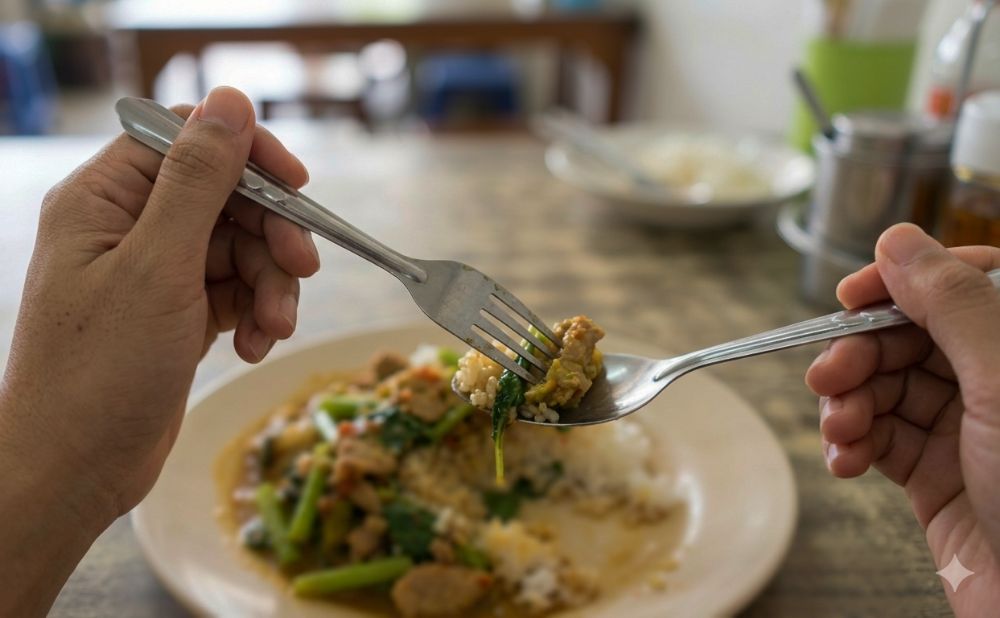
Dishes are ordered and shared across the table rather than individually. If you’re eating with Thais, don’t serve yourself everything you want from a shared dish at once — take a little, let it circulate, go back for more. Keeping rice on your own plate and spooning other dishes over it in small amounts is the natural rhythm of a Thai meal.
At someone’s home, finish what’s on your plate or close to it. Leaving large amounts of food is considered wasteful.
Tipping
Tipping isn’t embedded in Thai culture the way it is in the US, but it’s become expected in certain contexts — and getting it wrong in either direction creates awkwardness.
Massages are the clearest case. A 50 baht tip on a 200 baht foot massage is standard. For longer or more expensive treatments, 100 baht is reasonable. Not tipping at all after a massage is noticed. The therapists are often working long hours for a base wage that assumes tips will supplement it. If you’re unsure what to expect from a massage in Thailand, our Bangkok massage guide covers types, prices, and what to look for.
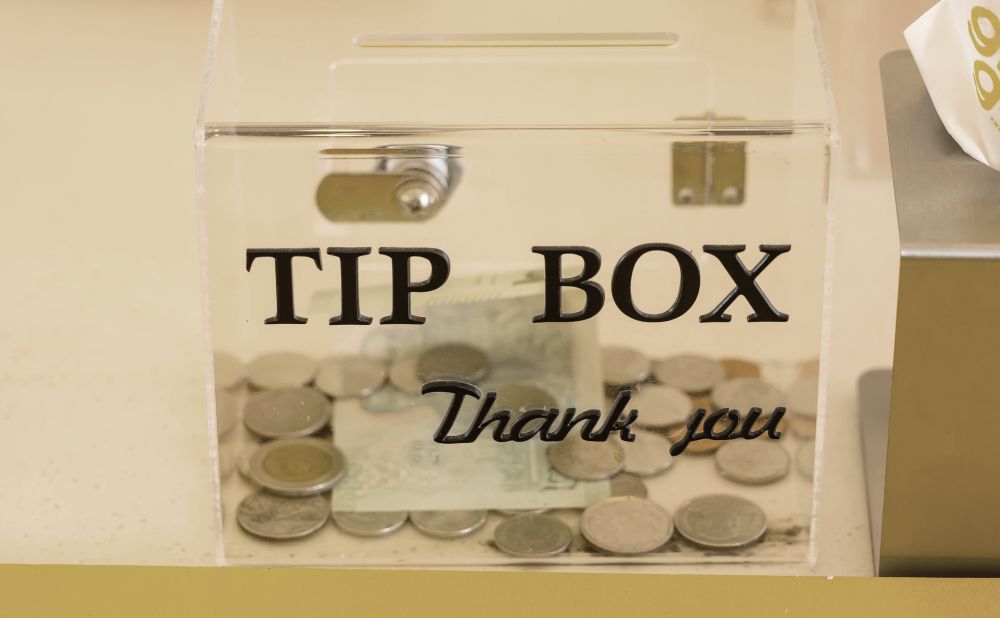
Restaurants vary. At street food stalls and local shophouse restaurants, tipping isn’t expected — leave the small change if you like, but don’t stress about it. At mid-range and tourist-facing restaurants a 20-50 baht tip is appreciated. At higher-end places, 10% is reasonable if service charge hasn’t already been added to the bill — check before you tip.
Taxis: if the driver uses the meter and is straightforward about it, round up or leave the change. It’s not obligatory but it’s appreciated. If you’ve negotiated a flat fare, tipping is less expected.
Hotel staff — porters, housekeeping — 20-50 baht is the norm. If someone has been genuinely helpful over a longer stay, more is appropriate.
The general principle: tipping in Thailand is about acknowledging service in roles where wages are low, not about rating performance. Keep small notes on you — fumbling for change undermines the gesture.
The Royal Family and Lèse-Majesté
Thailand’s lèse-majesté law makes it a criminal offence to defame, insult or threaten the King, Queen, heir or regent. The penalty is up to 15 years in prison per count. This isn’t a technicality that gets quietly overlooked — people are prosecuted under it, including foreigners, and the cases are handled by military courts.
The practical application is simple: don’t express negative opinions about the royal family, in any setting. Not at a dinner table with people you’ve just met, not on social media, not in a comment you think is harmless. If a conversation moves in that direction, change the subject.
The national anthem plays daily at 8am and 6pm in public spaces — parks, train stations, markets. When it does, people stop and stand. Do the same. In cinemas, the royal anthem plays before screenings and the audience stands. Follow the lead of those around you if you’re unsure.
Defamation and the Computer Crime Act
Defamation in Thailand is a criminal matter, not a civil one — meaning you can be arrested and prosecuted, not just sued. The Computer Crime Act extends this to anything posted online, and it catches expats and long-term visitors off guard more often than tourists.
If you’re thinking about posting a negative review or a frustrated comment on social media, there are a few things worth knowing.
Private chats aren’t necessarily private — a message in a Whatsapp group or direct message can be used as evidence if someone screenshots and shares it. Sharing or retweeting someone else’s defamatory post makes you equally liable. Deleting a post after the fact doesn’t remove the liability — screenshots and digital forensics are routinely used in these cases.
If you have a legitimate complaint about a business, stick to verifiable facts and keep emotion out of it.
Bargaining
Bargaining is appropriate in some contexts and completely inappropriate in others. Getting this wrong in either direction is awkward — haggling at a mall will get you nowhere. Not bargaining at a night market when it’s clearly expected leaves money on the table and occasionally puzzles the vendor.
Floating markets, street stalls, and independent souvenir shops — bargaining is expected. Floating markets in particular often open at significantly inflated prices; the opening figure is rarely the real one.
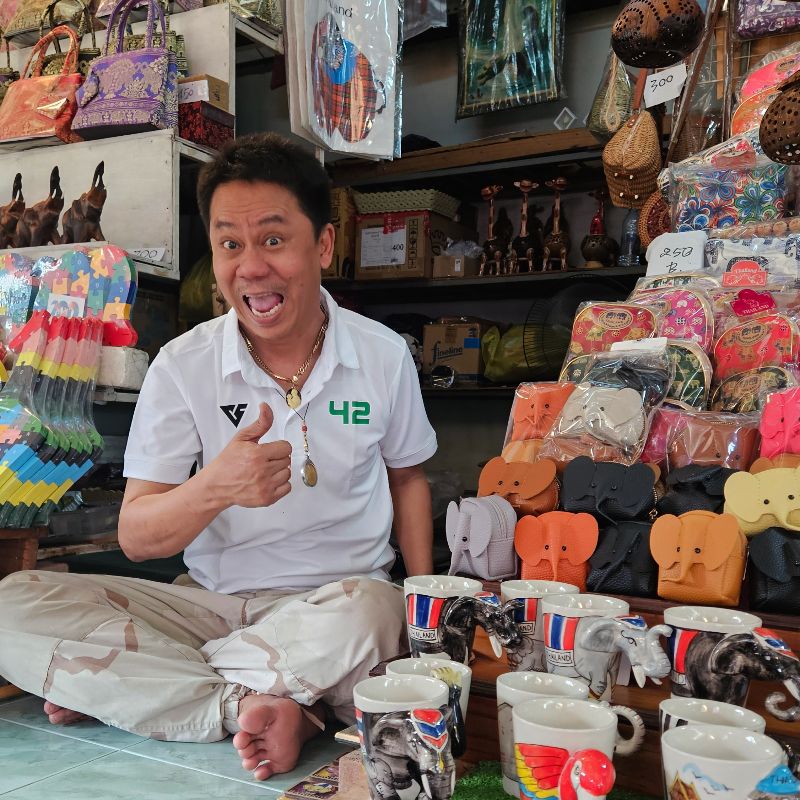
A reasonable approach is to counter at around 60-70% of the asking price and settle somewhere in between. Don’t open with an insultingly low offer and don’t walk away dramatically over a difference of 20 baht.
The grey area is independent guesthouses, smaller tour operators, and tuk-tuks or songthaews where no meter is involved. In these cases a polite negotiation is reasonable, but the manner matters.
Bargaining in Thailand works best when it’s conducted as a friendly exchange rather than a transaction you’re determined to win. If you get a price that seems fair, take it.
One thing I learned early: don’t ask the price of something you have no intention of buying. I did it once out of curiosity and the vendor’s irritation was immediate and entirely fair. Browsing is fine; asking a price signals intent.
A few other things that undermine the process: showing obvious enthusiasm for something before negotiating, bargaining aggressively and then not buying, and making the vendor feel you’re not taking the interaction seriously. The goal on both sides is a sale — keep it pleasant and it usually lands somewhere reasonable.
Photography
Thailand is photogenic in ways that make it easy to forget that a camera pointed at a person is a personal interaction, not just a compositional decision. The general rule is ask first, and if someone declines, accept it without negotiating.
At temples, photography of the buildings and grounds is usually fine. Inside the buildings, check for signs — some prohibit it, others don’t. When in doubt, watch what others are doing, or ask. Never position yourself in front of or above a Buddha image to get a better shot.
Monks are not props. If you want to photograph a monk, ask — some are comfortable with it, others aren’t. Don’t follow someone or position yourself repeatedly to get the shot you want.
Hill tribe communities and rural villages require more care than temples. These are people’s homes and daily lives. If you’re visiting as part of a tour, follow the guide’s lead. If you’re visiting independently, err heavily on the side of caution. Some communities have a complicated and not entirely positive history with being photographed by tourists, and awareness of that goes a long way.
Street photography in markets and public spaces is generally fine with common sense applied — a crowd scene is different from a close-up of an individual without their knowledge. If someone notices you photographing them and looks uncomfortable, move on.
One practical note: at some tourist sites, local people in traditional dress offer to pose for photos for a small fee. This is straightforward — if you want the photo, pay the fee. Don’t photograph them and then walk away without paying.
Public Displays of Affection and Keeping Your Cool
Thailand is more conservative about public affection than its reputation as a tourist destination sometimes suggests. Holding hands is fine. Kissing, embracing, or anything more demonstrative in public — particularly outside of tourist-heavy areas — draws attention and not always comfortable attention. Read the environment.
Public displays of anger are a more serious issue, and worth understanding clearly. Losing your temper in public — raising your voice, making aggressive gestures, getting into a confrontation — is considered deeply inappropriate in Thai culture.
It also carries practical risk. Police can and do arrest people for disorderly conduct, and a situation that might resolve itself with an argument in another country can escalate quickly here if you push it.
The concept of face matters in every interaction. Backing someone into a corner, humiliating them publicly, or refusing to let a situation de-escalate gives the other person nowhere to go. Even if you’re entirely in the right, the manner in which you handle it affects the outcome.
This applies in everyday situations — a billing dispute, a motorbike scrape, a disagreement with a landlord — as much as anything more serious. The approach that works is staying calm, keeping your voice level, and finding a way for everyone to walk away without having lost face. It’s a reflex that takes practice if you’re not used to it, but it’s worth developing early.
If you feel yourself getting frustrated, disengage and come back to it. That’s not losing — it’s how things get resolved here.
Festivals
Thailand’s festivals are worth planning a trip around, but they come with their own etiquette.
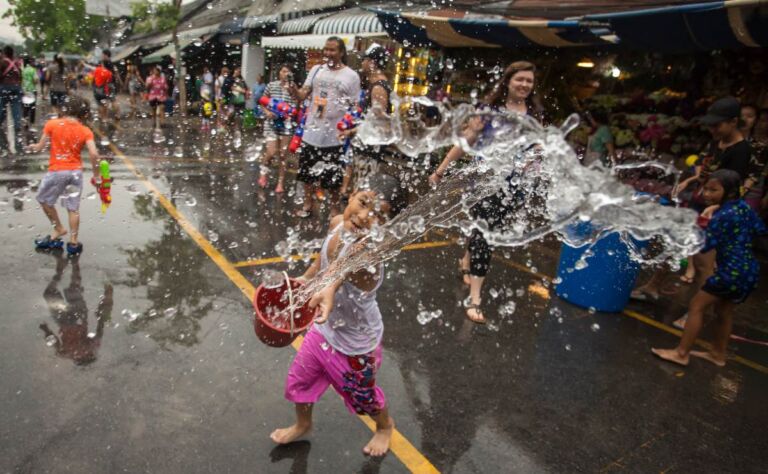
Songkran, the Thai New Year in April, is the most visible. The water-throwing that happens in tourist zones — Silom in Bangkok, Nimman in Chiang Mai, the full length of Hua Hin’s main street — is a street party, and if you’re in it, you’re fair game. That’s understood by everyone involved.
What’s less understood by some visitors is that outside those areas, or in more traditional settings, Songkran is a religious and family occasion. Visiting temples, making merit, and the gentle pouring of water over elders’ hands as a mark of respect is the older tradition underneath the street festivities. Both exist simultaneously.
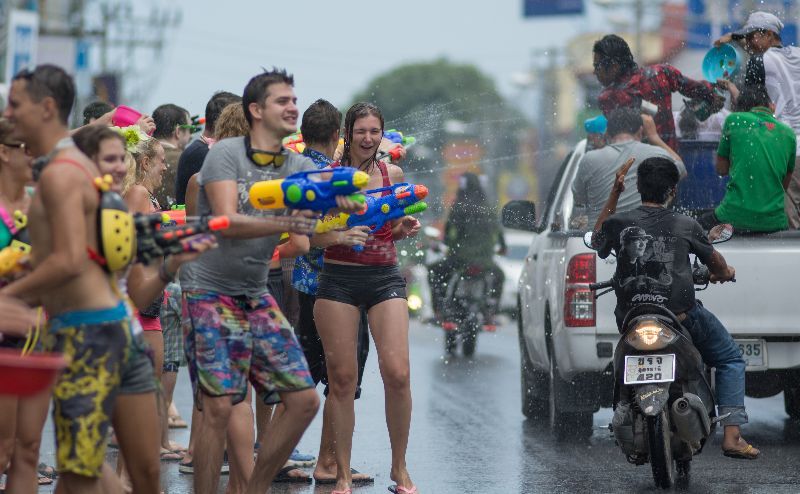
For a full breakdown of dates, locations, and what to expect, see our Songkran 2026 guide.
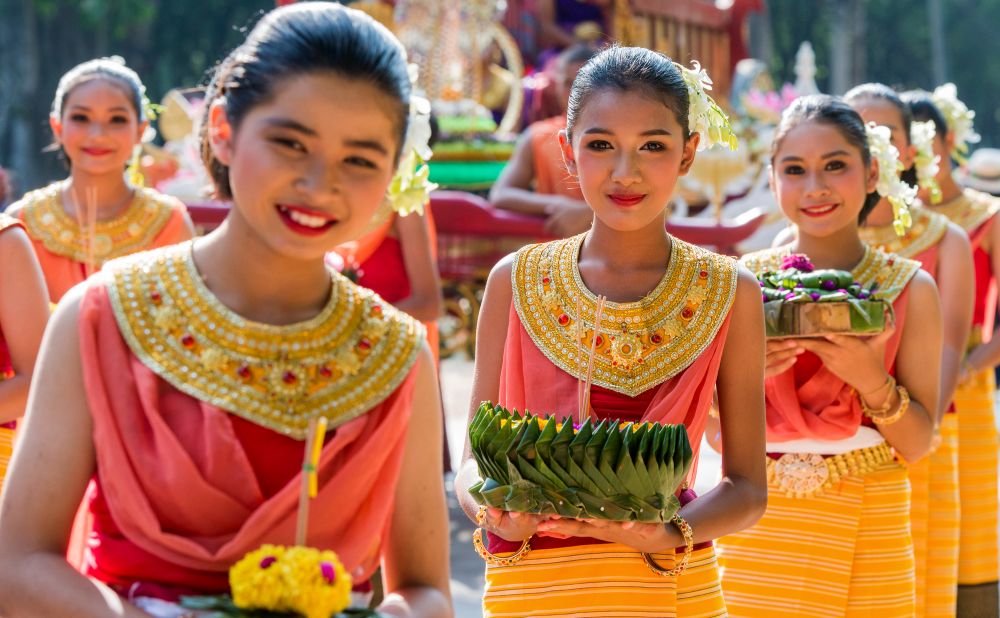
Loy Krathong happens in November at full moon. This is actually my favourite Thai Festival. You release a small float — krathong — onto water as an offering. In some places, sky lanterns are released at the same time.
During our first year living in Bangkok we joined a Krathong making party in our condo. All the materials were supplied and neighbours invited us to join in. One man abandoning his own creation to help as I fumbled with banana leaves and sharp pins. He took as much joy in my completed offering as his own.
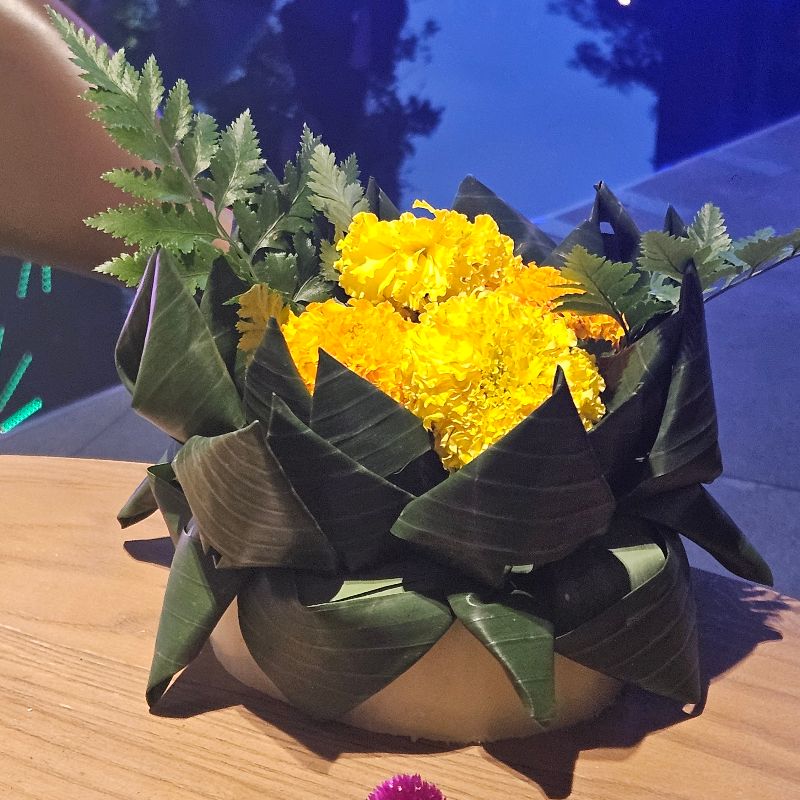
If you’re releasing a lantern, be aware that they’re banned in some areas, particularly near airports, and the ban is enforced. Check before you buy one from a vendor who may not volunteer that information.
At any festival involving temple ceremonies or religious observance, the same rules apply as any other temple visit — dress appropriately, don’t obstruct ceremonies to take photos, and follow the lead of the Thais around you rather than the tourists.
Buddhist holidays — there are several throughout the year — mean no alcohol sales on most days. In practice, some venues are exempt from the ban and you can usually find somewhere serving if you look hard enough. But it’s worth asking whether you need to. Join the locals and take a day off.
Immigration Officials
Thai immigration is an unavoidable part of life here, whether you’re arriving at the border, extending a visa, doing your 90-day report, or dealing with a TM30. The process is often slow, occasionally confusing, and runs entirely on its own terms. Your job is to work with that rather than against it. For an overview of visas and entry requirements, our Thailand trip planning guide covers the basics.
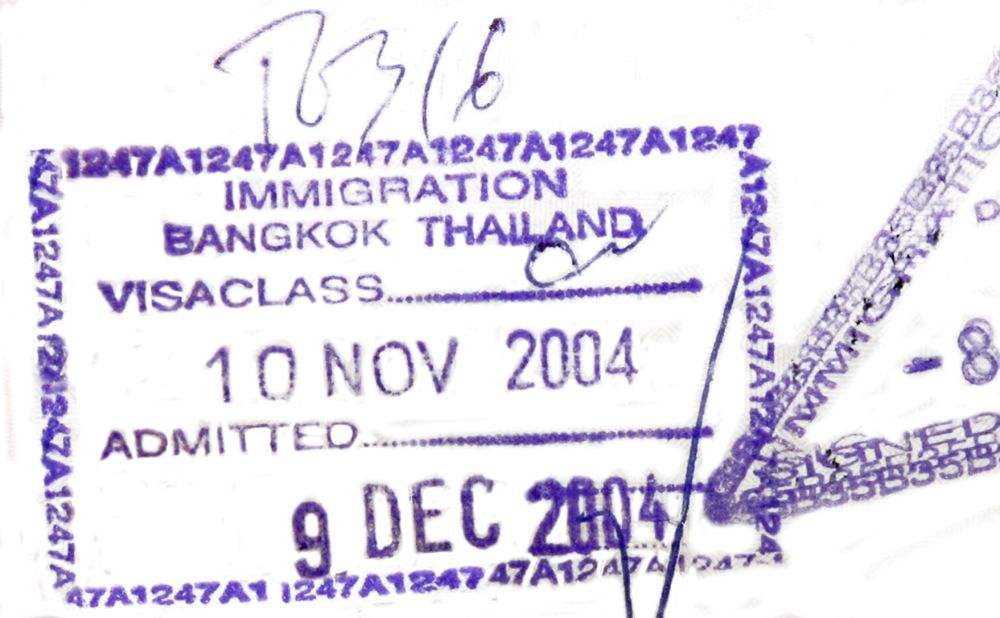
The most important thing to understand is that immigration officers have significant discretionary power. A calm, organised, respectful person gets a different experience than someone who arrives flustered, argues about the queue, or makes clear they think the process is an inconvenience beneath them. This isn’t unique to Thailand, but the gap between the two outcomes is wider here than in many countries.
Have your documents in order before you reach the counter — not while you’re standing at it. Know what you’re applying for and what you need. If something is missing, acknowledge it politely and ask what your options are.
Raising your voice or demanding to speak to someone senior is rarely effective and occasionally makes things considerably worse.
For expats, the bureaucratic rhythm of 90-day reporting, visa extensions, and re-entry permits becomes routine, but routine doesn’t mean relaxed. Deadlines matter. Overstaying a visa, even by accident, results in fines and can affect future applications. Keep track of your dates and don’t leave things to the last minute — immigration offices in major cities can have long queues, and “the queue was too long” is not a mitigating circumstance.
At land borders, patience is the only useful tool. Crossing times vary enormously depending on the day, the border, and factors entirely outside your control. Bring water, something to read, and no particular expectations about how long it will take.
In two years I have no dramatic immigration stories, which I suspect is the point. We’re always polite, always organised, and it has never been difficult.
If you want more tips or advice for planning your trip, you can join our Facebook group: Thailand Awaits Trip Planning for Beginners. It’s a place to ask questions, get help from other travellers and locals, and find free resources for your Thailand holiday.
* Main image is Ai generated