Thai Food by Region: What to Order and Where
I’ve been visiting Thailand for twenty years and living here for two. When you’re visiting, every meal carries a bit of pressure — you have a limited number of them and a bad one stings. When you live somewhere, that changes. You stop being cautious. You order the thing you can’t identify because there’s always another meal tomorrow. That’s when the food really opens up.
This guide covers the four main culinary regions. You’ll understand why a curry in Chiang Mai tastes nothing like one in Bangkok, how to order like someone who actually lives here, and why some dishes you think of as traditional Thai aren’t particularly traditional at all — including Pad Thai.
A Word on Pad Thai
Pad Thai is the dish most visitors arrive knowing, so it deserves a mention. It exists, it can be good, and you’ll find it everywhere — but it isn’t the everyday dish that decades of western Thai restaurant menus suggest. It was actively promoted by the Thai government in the 1940s as part of a national identity campaign and caught on internationally in a way that made it shorthand for a cuisine it barely represents.
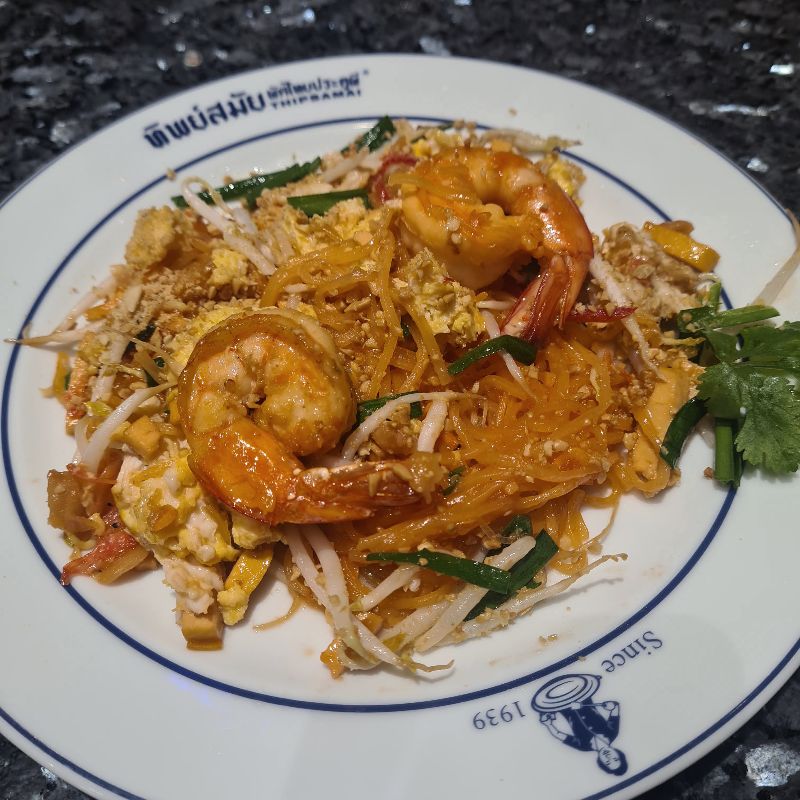
In a local Bangkok restaurant you’re far more likely to see pad krapow, khao man gai, or a bowl of noodle soup. This guide is about those dishes.
How Thai People Actually Eat
Forget ordering one dish per person. That’s a western habit and it doesn’t work here either practically or culturally. In Thailand, meals are built around sharing. Sit down at a local restaurant and you’ll see families and groups of friends ordering four or five dishes between them, everyone taking small amounts from each plate throughout the meal.
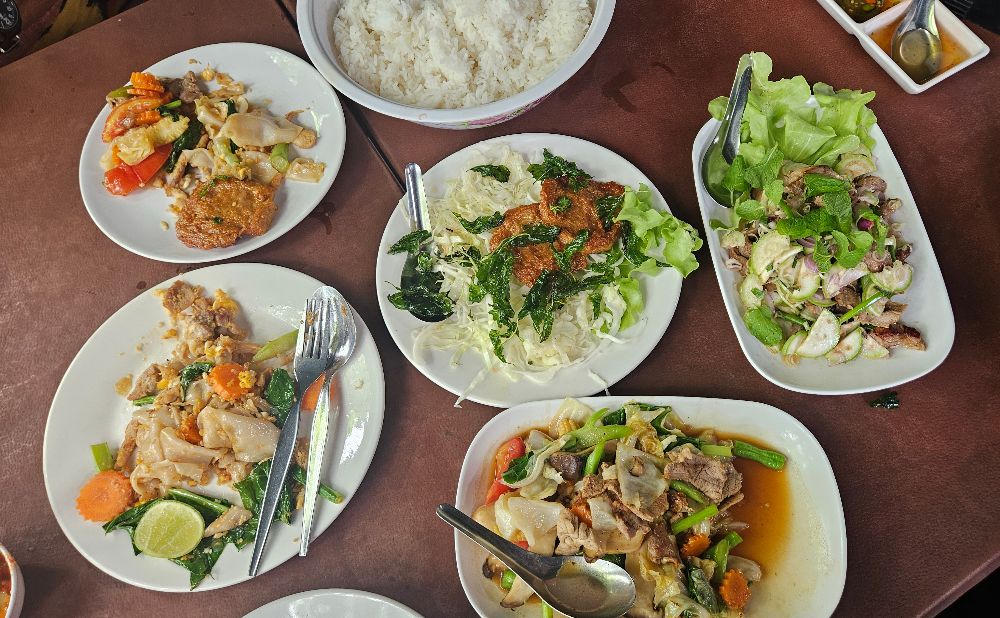
A shared meal generally builds across a few categories — something wet like a curry or soup, something dry like a stir-fry, and a salad or fresh vegetables alongside. The contrast between them is the point. One dish from each and you have a balanced table; two from the same category and something feels off.
I’ve come to love this style of eating. It’s how you end up trying things you’d never order for yourself — several dishes I now actively seek out started as small tastes from someone else’s plate that I wouldn’t have risked as my only meal. Ordering your own dish in this context usually means you’ll finish before the next person has been served, which rather defeats the purpose.
Rice is served separately, and the type changes depending on which region you’re in.
Understanding Thai Flavours
Thai food is not all “hot and spicy” any more than all French cooking is “buttery.” Each dish balances at least two or three fundamental tastes simultaneously, often four or five. A single bite might move from salty to sour to sweet, with heat building quietly underneath. That layering is what makes it satisfying rather than just intense.
The key flavours in Thai cooking:
- Fish sauce (nam pla) — the backbone of saltiness, but also adds a savoury depth that salt alone doesn’t.
- Sour notes — lime juice for brightness, tamarind for complexity, young green mango for sharp tang.
- Palm sugar — nothing like refined sugar. It adds richness and rounds out sharper flavours.
- Chillies — fresh ones give immediate heat, dried ones a slower, deeper burn. They’re not interchangeable.
- Bitter ingredients — herbs and vegetables that often go unnoticed but keep everything from tipping too sweet or too rich.
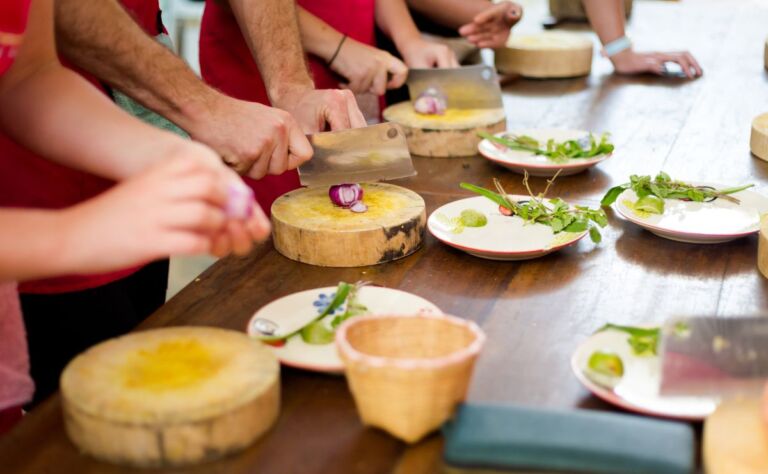
If you’re based in or passing through Hua Hin, I’ve done the Hua Hin Thai Cooking Course and would recommend it as a starting point. It’s a half day — a market tour first so you understand the ingredients before you cook them, then hands-on cooking, a sit-down meal of what you’ve made, and a certificate to take home. It covers the fundamentals and gives you a real sense of how the flavour balancing actually works. We have also done classes in Bangkok.
Thailand’s Four Food Regions
Thailand’s food changes as you travel through the country — not gradually, but quite sharply. Each region has its own climate, history, and cultural influences, and those factors show up directly on the plate.
The North (Lanna Cuisine)
Northern food is shaped by a cooler climate and centuries of Burmese and Lao influence. You’ll find abundant fresh herbs and bitter vegetables, more aromatic complexity than outright heat, very little coconut milk, and pork as the default protein. The main carbohydrate is sticky rice, eaten with your hands.
The Northeast (Isaan)
Isaan food is direct and bold. Cooking methods are simple — grilling, pounding, raw assembly — but the flavours are intense, built on fermented fish sauce, preserved fish, and fresh chilli. Sticky rice comes with everything. Clear soups rather than coconut curries, raw vegetables alongside most meals.
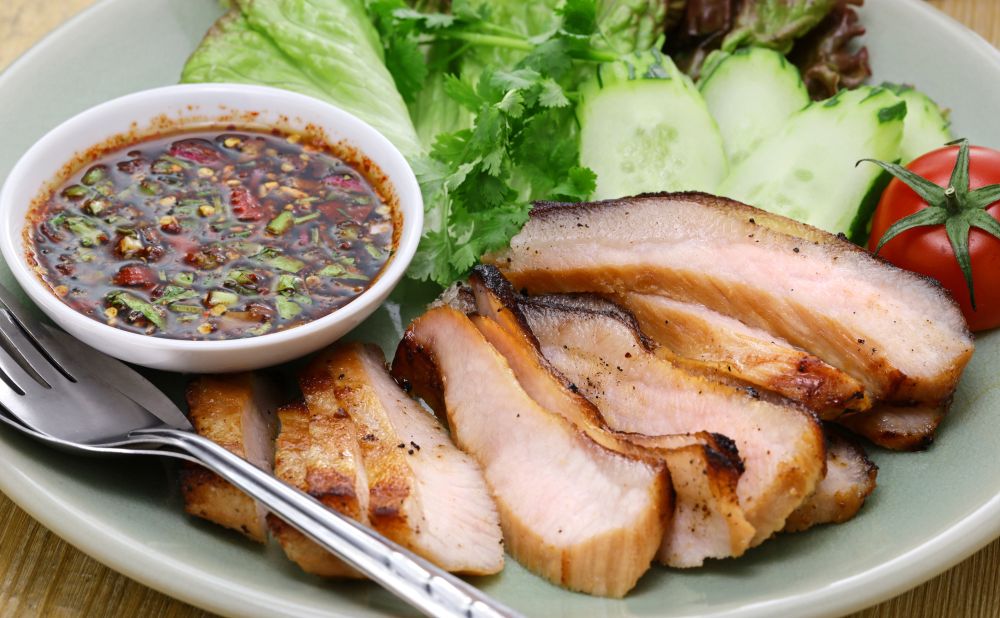
Central Thailand
Central Thai cooking developed partly to serve the royal court, which means more elaborate preparation and presentation than you’ll find elsewhere. This is what most foreigners recognise as Thai food.
Jasmine rice replaces sticky rice, Chinese technique influences many dishes, and the balance of sweet, sour, salty, and spicy is more deliberate and refined. The widest variety of dishes comes from this region.
The South
Southern food is the spiciest in Thailand. Muslim and Malay influences shape the curries, which use distinct spicing heavy on turmeric and dried chilli. Fresh seafood dominates. Dishes are less sweet than central Thai food and considerably more sour and spicy. Some ingredients here are essentially unknown in other parts of the country.
I’ll be honest, the south is the region where I am most fussy. Not because of the heat but because fermented fish runs through southern cooking in a way that’s not always obvious from the menu. I love fresh fish and seafood, and the south has excellent versions of both. But fermented fish paste and fermented fish sauce turn up in salads, curries, and dipping sauces in a way that can catch you off guard if you’re not expecting it.
That’s not a reason to avoid the region. It’s a reason to ask before you order, and possibly to do the Chef’s Tour Phuket early in your stay — it explained more about the history of the city and the mix of Chinese, Malay, and Indian influences on the food than anything I’d read before.
Essential Dishes by Region
Northern Thailand
Meals in the north are built around sticky rice eaten with your hands, with dishes designed for dipping and sharing rather than eating individually.
Khao Soi (ข้าวซอย)
A rich curry noodle soup — egg noodles in a coconut-based broth, topped with crispy fried noodles and served with pickled mustard greens, shallots, and lime on the side.
I have rarely had a bad one. Even the refrigerated version at Seven Eleven — 45 baht, reheated in the microwave — makes me happy, which tells you something about how forgiving the dish is when the base is right.
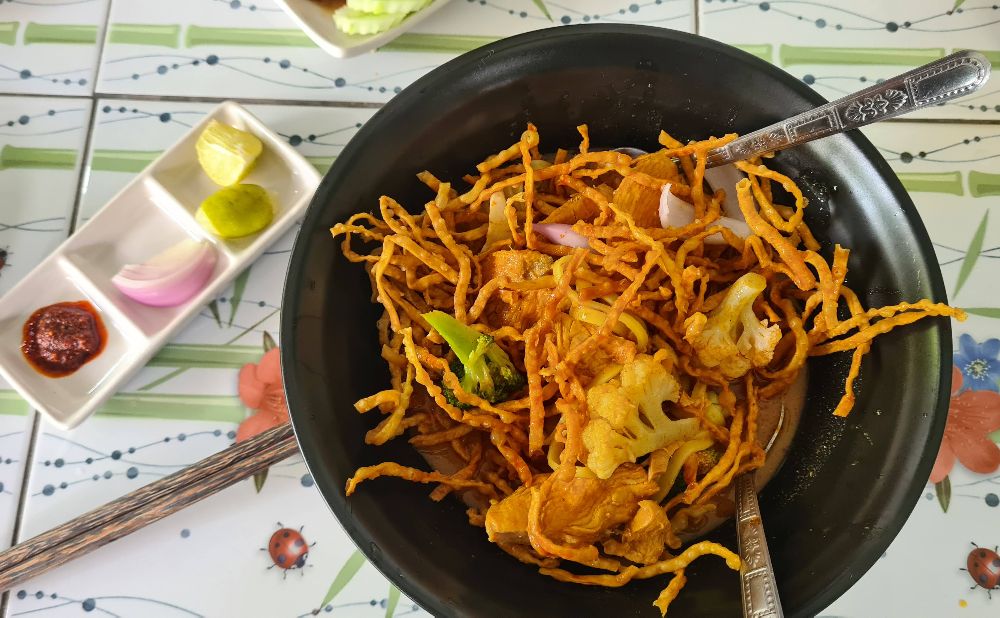
My benchmark is Nun’s Restaurant in the Chiang Mai old town. I don’t remember who recommended it but I visited for the first time three years ago, and still remember that bowl clearly.
In Bangkok, the Ongtong Khao Soi chain has several outlets — the Ari branch is the one I go back to. In Hua Hin, Khao Soi Northern Thai Food Lanna Style on Soi 102 is reliable enough that I stop thinking about alternatives.
Order the chicken drumstick rather than breast — the meat holds up better in the broth. Eat it at lunch. It’s a heavy dish and by dinner it sits differently. The crispy noodles on top go soft quickly so eat it as soon as it arrives.
Sai Oua (ไส้อั่ว) — Northern Sausage
Pork sausage heavily seasoned with lemongrass, galangal, kaffir lime, and dried chilli. The flavour profile is completely different from central Thai or Isaan sausages and much tastier than a western sausage. Buy it at morning markets when it’s freshly made and still warm from the charcoal.
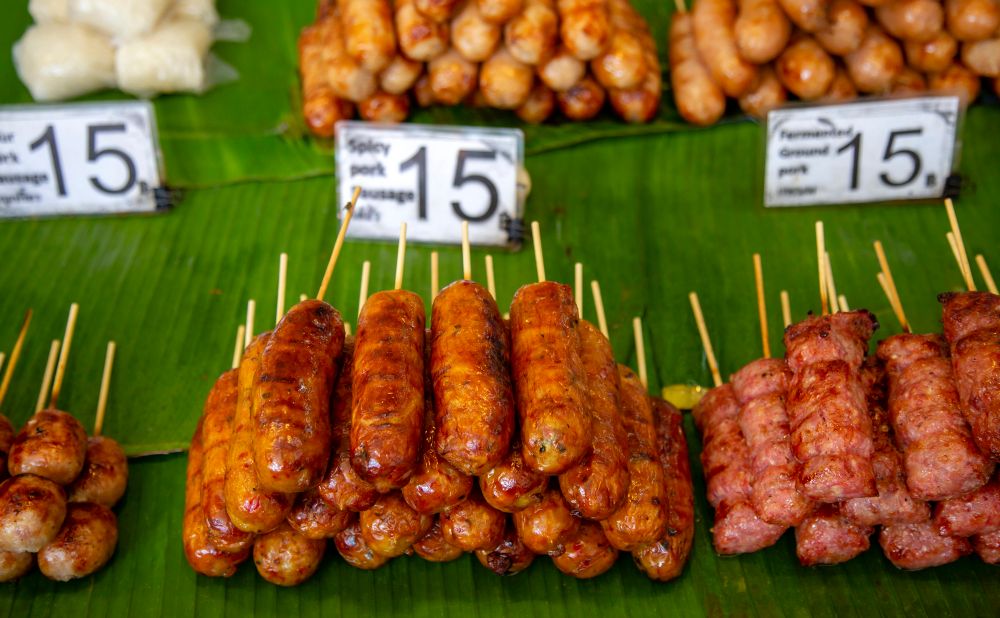
Warorot Market in Chiang Mai is a reliable spot. Eat it with nam prik noom and sticky rice, or just as a snack while you’re walking the market.
Nam Prik Noom (น้ำพริกหนุ่ม) — Roasted Green Chilli Dip
A smoky, slightly bitter dip made from roasted green chillies, garlic, and shallots. In northern homes it’s everyday food; in tourist areas it’s often dressed up unnecessarily. The best versions are at local restaurants serving traditional northern dishes or at weekend markets where someone has made it that morning. It’s good for breakfast with boiled eggs and sticky rice, which sounds odd until you try it.
Northeastern Thailand (Isaan)
Isaan cooking is the food most Thais from other regions claim they can’t handle. Order it at the spice level locals eat and you’ll understand why.
Som Tam (ส้มตำ) — Green Papaya Salad
Shredded green papaya pounded with chilli, garlic, lime, fish sauce, and palm sugar. The version most visitors encounter is som tam thai — milder, with peanuts and dried shrimp. Som tam poo adds pickled crab. Som tam plara uses fermented fish sauce instead of regular fish sauce, much stronger, and the version locals actually prefer. Watch how they make it. If they taste it and adjust the seasoning, that’s a good sign.
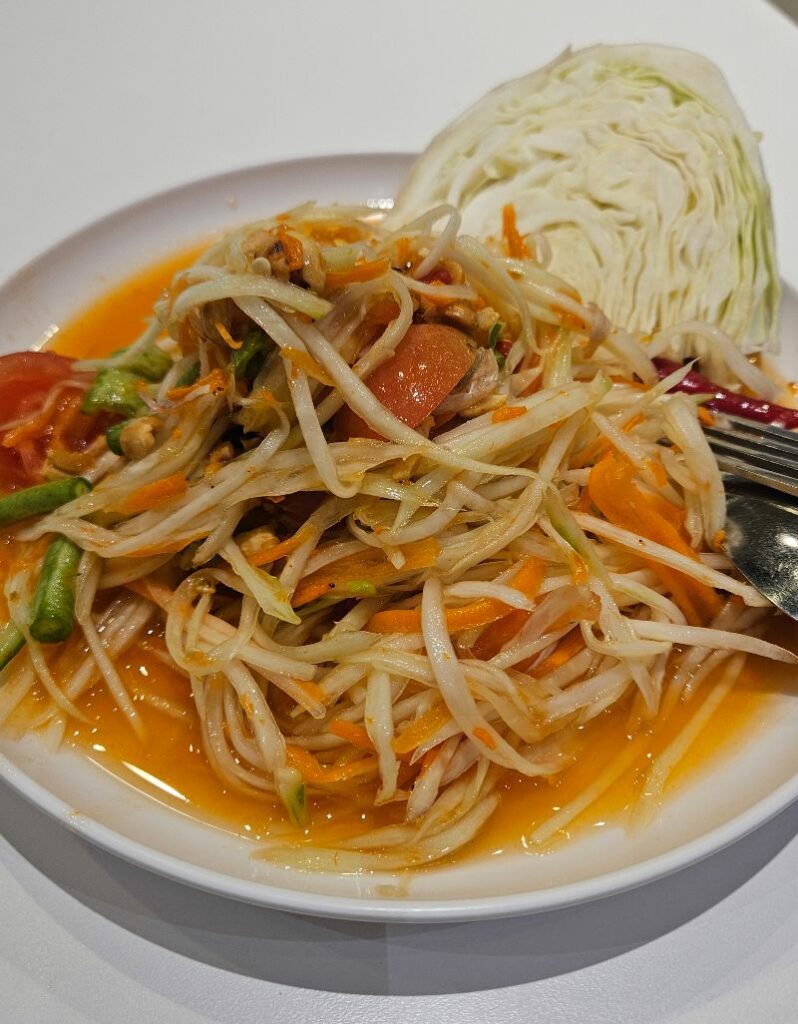
- Som Tam Thai — milder, with peanuts and dried shrimp. The version most tourists encounter.
- Som Tam Poo — with pickled crab. Usually available after 10am when the crabs arrive.
- Som Tam Plara — made with fermented fish sauce rather than regular fish sauce. Much stronger and the version locals actually prefer.
Som tam is the papaya version but that’s just the starting point. After years of ordering it I find myself reaching for the variations more often than the original.
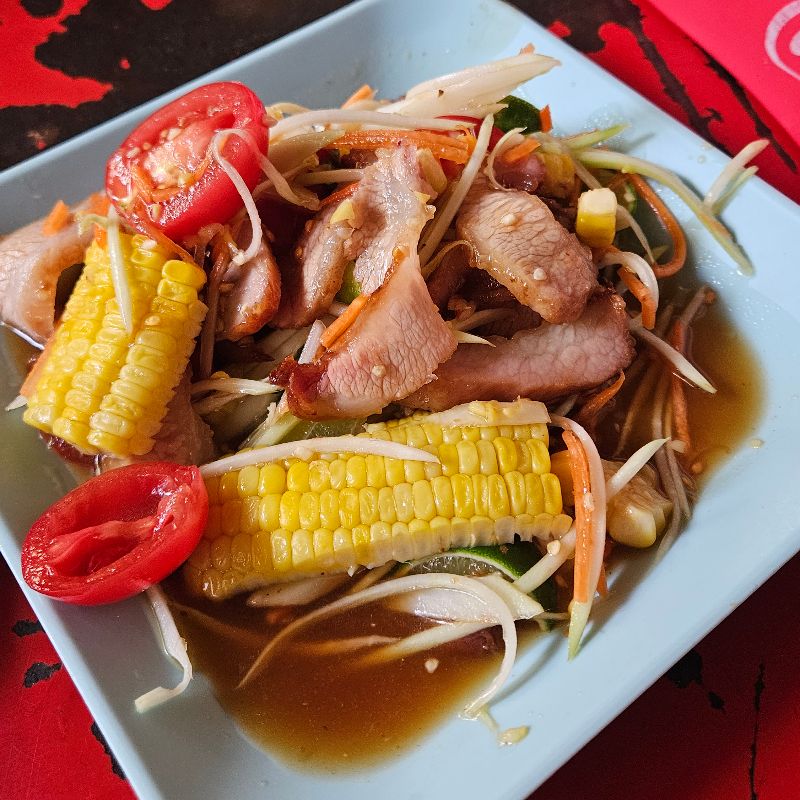
Tum khao pod is corn salad. The sweetness of the corn takes the dressing somewhere the papaya version doesn’t go, and because the kernels don’t absorb it the way shredded papaya does, it sits in a shallow pool that you end up eating with a spoon. Order it tum thai style — sweet, salty, tangy. It’s the version I’d send a first-timer to.
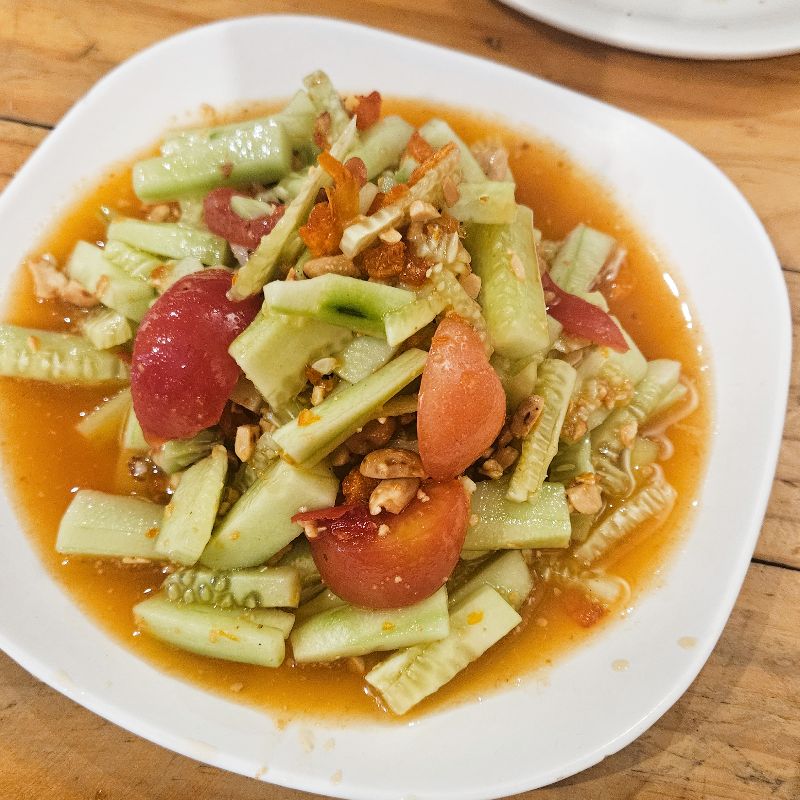
Tum tang is cucumber salad and the most refreshing of the three. The cucumber is chopped roughly rather than shredded, which keeps it crunchy, and the lime and chilli dressing is lighter than the papaya version. Stick to tum thai style here too — there’s a fermented fish sauce version that locals love but it overwhelms the whole point of the dish. Eat it quickly. It goes soupy fast and that’s when it loses the point.
Late morning is the best time — papayas are freshly shredded and the vendors are busy. Look for queues. There are several versions worth knowing:
Laab (ลาบ) — Minced Meat Salad
Minced pork or chicken (sometimes beef or duck) tossed with toasted rice powder, fish sauce, lime, dried chilli, and a pile of fresh mint. Order it at the lunch rush — 11am to 1pm — when the herbs are fresh and the kitchen is at full pace.
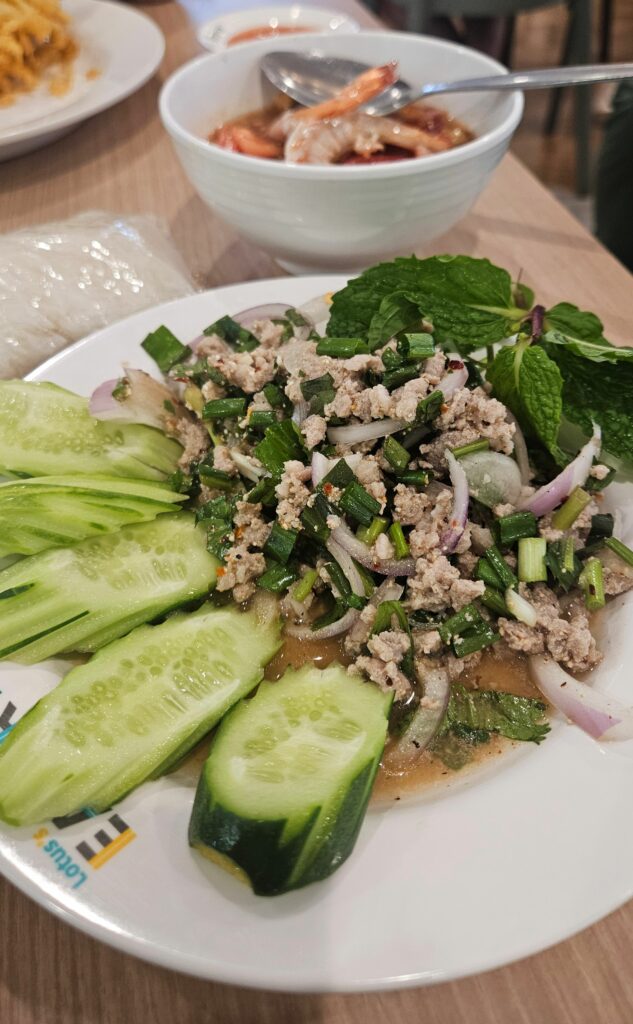
Eat it with sticky rice and raw vegetables. There are raw versions (laab dip) but these require properly sourced, freshly butchered meat and expert preparation; unless you’re at a restaurant that clearly specialises in it and the locals are ordering it confidently, stick to the cooked version. I have yet to be brave enough.
Gai Yang (ไก่ย่าง) — Grilled Chicken
Whole or half chicken marinated in lemongrass, garlic, and fish sauce, grilled slowly over charcoal. The best spots run out before 6pm.
If you smell it from the street, stop. Order it with som tam and sticky rice — that combination is so standard it’s almost become its own dish. The fresh vegetables served alongside aren’t garnish; use them to pace the spice.
Central Thailand
This is where the dishes most people recognise from Thai restaurants abroad actually come from, though the local versions are usually sharper, less sweet, and considerably more varied.
Pad Krapow (ผัดกระเพรา) — Holy Basil Stir-Fry
This is possibly the most popular Thai dish among locals and expats. You will find it everywhere. Most often it’s minced pork or chicken stir-fried with holy basil, garlic, and chilli. Street stalls and food courts, at lunch. Pad Krapow should come with a fried egg on top — the yolk should be runny. You will also find seafood and crispy pork versions, for when you are feeling fancy.
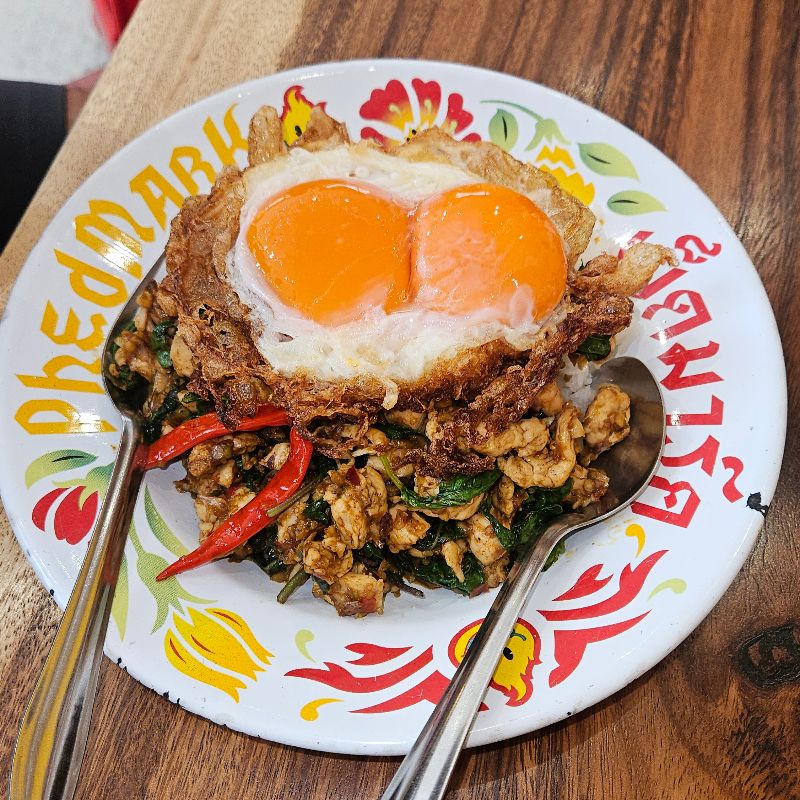
If you want to order it the way Thais do: “krapow kai kai dao” gets you chicken with egg. The holy basil matters — regular basil gives a completely different result and some places substitute it without mentioning that they have.
Khao Ka Moo (ข้าวขาหมู) — Braised Pork Leg
The ultimate comfort food, pork leg braised slowly until soft, served over rice with the cooking liquid, a boiled egg, and pickled mustard greens. Look for big bubbling pots of pork leg at the front of the stall.
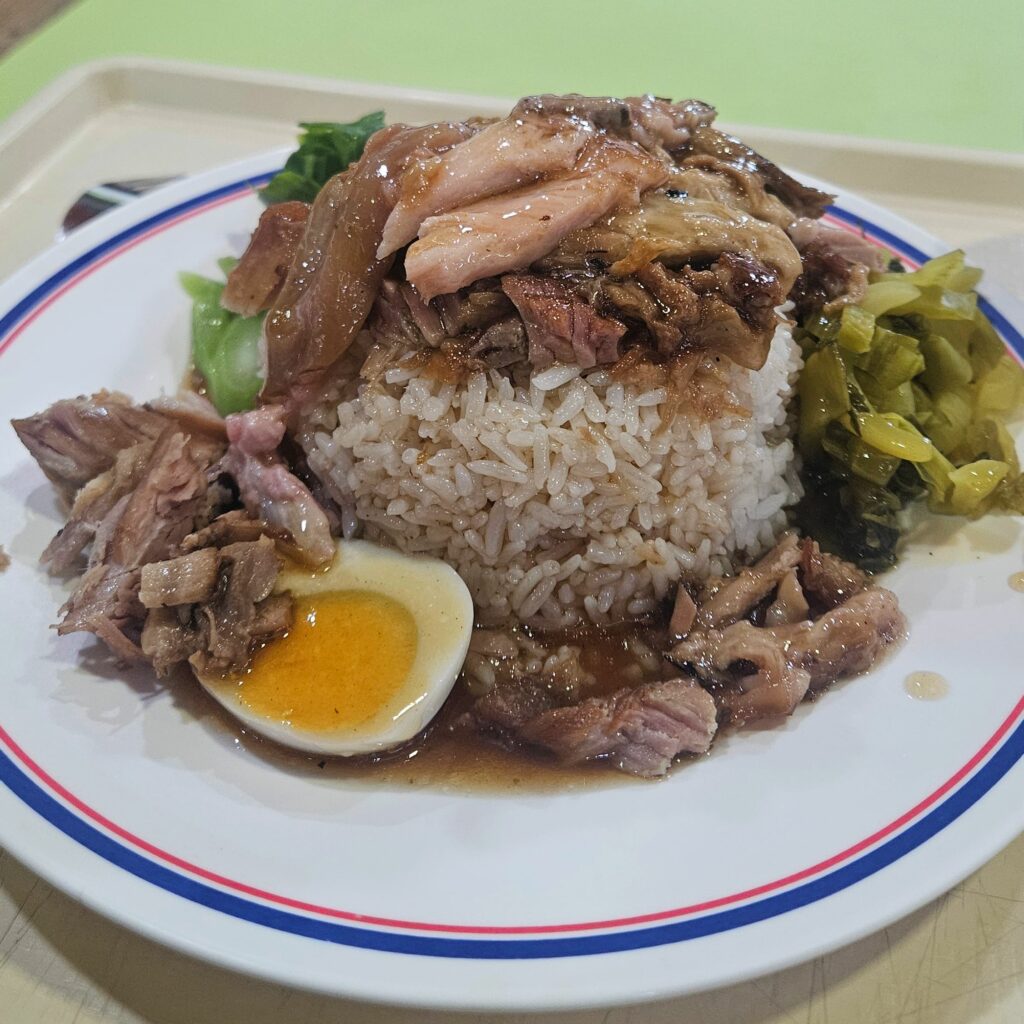
Early afternoon is when the meat is most tender, before the best cuts sell out. Pickled mustard greens and chilli vinegar on the side are not optional — they cut through the richness.
Khao Man Gai (ข้าวมันไก่) — Poached Chicken Rice
Chinese-Hainanese in origin, now completely embedded in everyday Bangkok eating. Poached chicken served over rice cooked in the chicken broth, with a clear soup on the side and a ginger and fermented soybean dipping sauce.
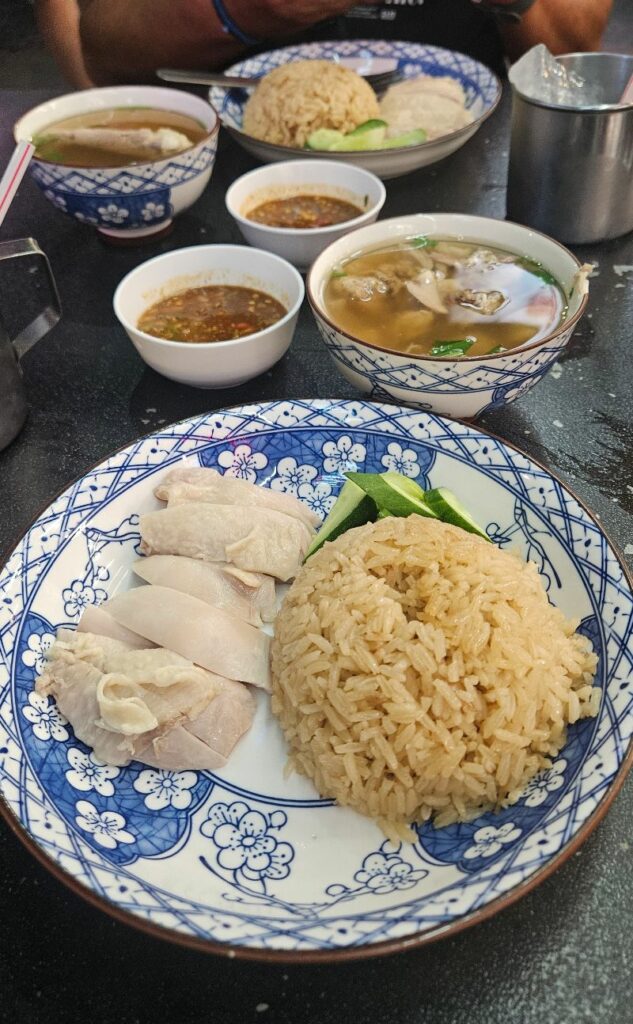
It’s cheap, it’s everywhere, and it’s rarely on the radar of first-time visitors. The dish reads as plain until you use the dipping sauce — that’s where the flavour is. Good at breakfast or lunch from dedicated shophouses that often do nothing else. My favourite comes from Jack’s Chicken Rice stall in Bangkok.
The Curries
Green curry (gaeng keow wan), red curry (gaeng daeng), and massaman are all central Thai dishes, though massaman has Persian and Malay roots that arrived via the south centuries ago. All three use coconut milk, which is what distinguishes central Thai curries from the drier, fiercer curries of the south.
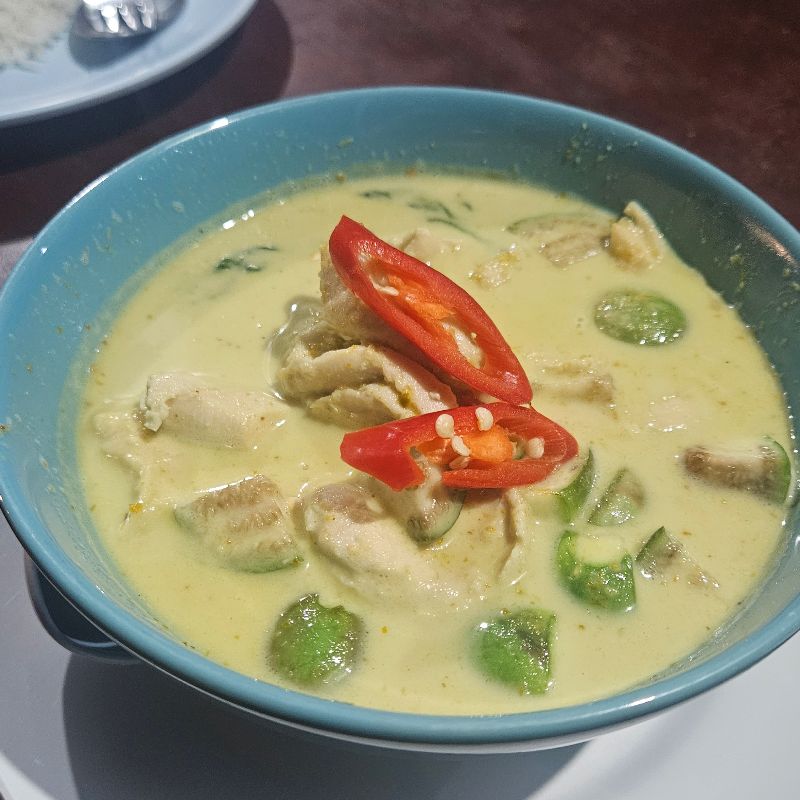
- Green curry is the most pungent — fresh green chillies, kaffir lime, and Thai basil give it a sharp, herby heat.
- Red curry is slightly milder and sweeter, often containing bamboo shoot or pumpkin.
- Massaman is the mildest: slow-cooked with potato, onion, and roasted peanuts, with warm spicing from cardamom and cinnamon that reflects its origins.
At a local shophouse at lunchtime any of these will be hotter, less sweet, and considerably better than almost anything in a tourist-facing restaurant.
The Soups
Tom Yum Goong (ต้มยำกุ้ง) — Spicy Prawn Soup
The broth should be clear, not orange, and definitely not creamy — those versions are adaptations. Fresh galangal and lemongrass in whole pieces floating in the bowl are a good sign.
This is lunch food best ordered as one dish in a shared meal with rice and something dry to contrast it. Order from local restaurants rather than tourist-facing menus and the version you get will be sharper, more sour, and less sweet.
Kuay Teow Reua (ก๋วยเตี๋ยวเรือ) — Boat Noodles
Small bowls of pork or beef noodle soup with a dark, slightly thick broth. Order three or four at a time, the way locals do — they’re intentionally small.
The Victory Monument area in Bangkok has the most concentrated collection of boat noodle shops. The pile of empty bowls building up on the table is both a practical counting system and, if you’re at a busy stall with bowls stacked everywhere, a reliable indicator of how popular the place is.
Southern Thailand
If you’ve eaten spicy food confidently everywhere else in Thailand, the south will recalibrate your scale. Start milder than you think you need to.
Gaeng Tai Pla (แกงไตปลา) — Fermented Fish Curry
A very spicy curry made with fermented fish innards, mixed vegetables, and bamboo shoots. This is not a dish to order unless you’re confident about your chilli tolerance — even many Thais from other regions find it too hot.
Start with a small amount mixed into rice rather than eating it straight. The flavour is complex and funky in a way that’s either immediately appealing or completely off-putting; there’s not much middle ground.
Satay (สะเต๊ะ) — Grilled Skewers
The southern version of satay is different from what you’ll find elsewhere in Thailand and completely different from the peanut-sauce-heavy version that became standard in western Thai restaurants. In the south, fish satay is common and worth trying.
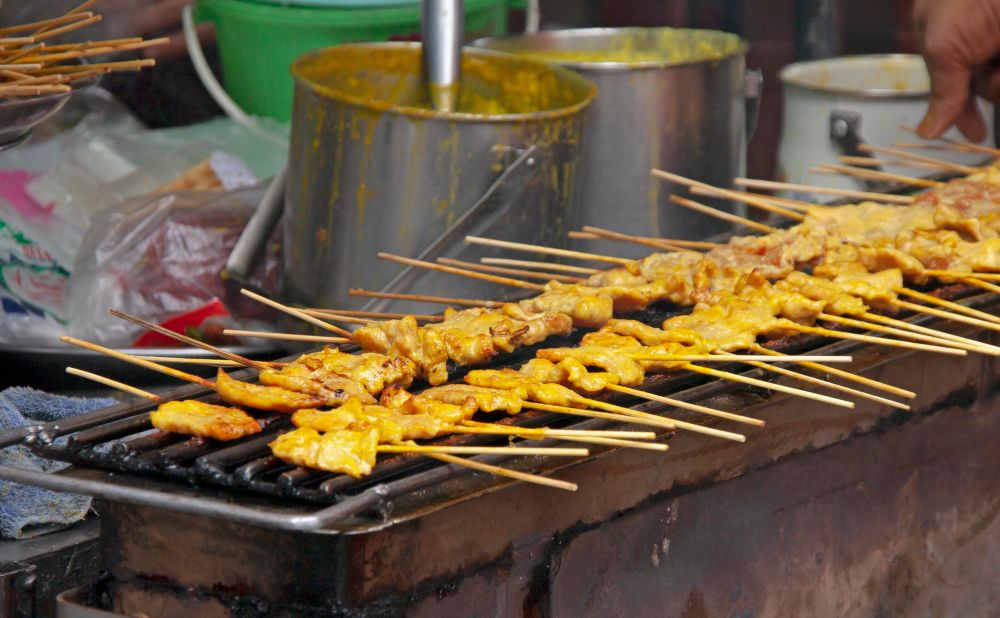
The dipping sauce here is a thin, spiced curry sauce rather than peanut sauce. Best in the late afternoon as street-side grills start up, when you can smell the charcoal smoke before you see the stall.
Khua Kling (คั่วกลิ้ง) — Dry Southern Curry
Minced meat stir-fried with a dry curry paste heavy on turmeric and dried chilli, no coconut milk. The colour is bright yellow-orange and the smell of the spice paste, particularly in the morning when it’s freshly ground, is unmistakable.
This is one of the hottest dishes in a very hot regional cuisine. Order it mild your first time. A plate of fresh herbs alongside helps manage the heat.
When to Eat What
Thai people eat at specific times for practical reasons — ingredients are at certain stages of freshness, vendors set up and pack down on predictable schedules, and the logistics of the heat mean that heavy cooking happens in cooler hours.
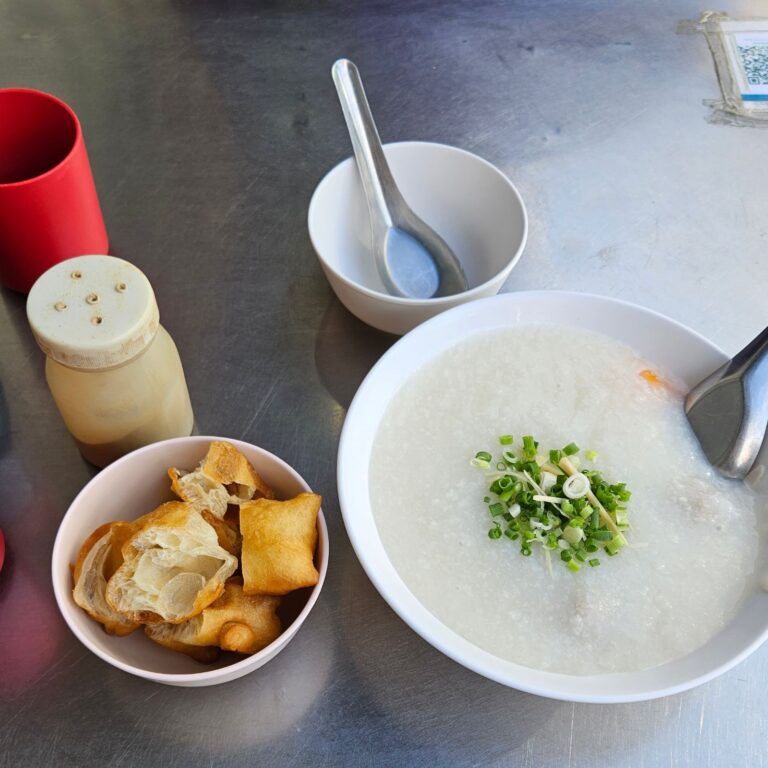
6–9am is when morning markets are at their best. Jok (rice porridge) vendors are busy before 7am; patongo (Thai-style fried dough) is worth eating only when it’s hot from the oil. Khao tom (rice soup) and fried chicken is good at this hour and also, less obviously, good after a late night.
9–11am is when curry shops and grills start up. Good time to watch food being prepared and to eat a substantial late breakfast.
11am–2pm is peak lunch. The best local restaurants fill quickly and some sell out of popular dishes before 1pm and close entirely by 2pm. Food courts offer reliable value at this time.
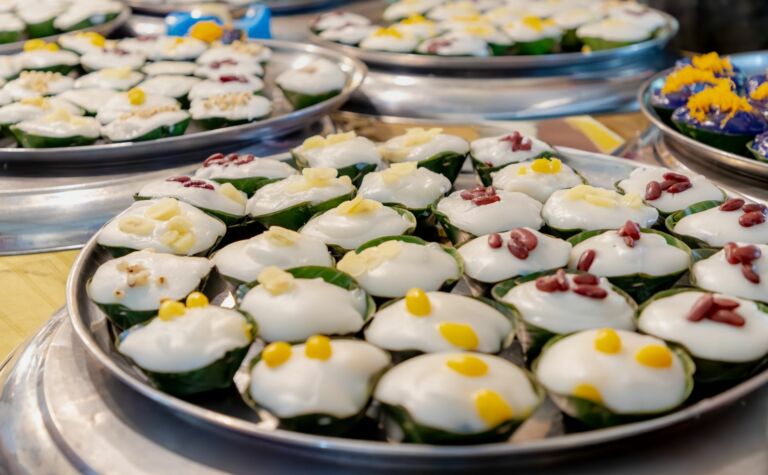
2–5pm is quieter. Dessert shops do steady business, boat noodle vendors are accessible without queuing, lighter eating works well in the heat.
After 5pm is when night markets and street food stalls properly open. Seafood restaurants take fresh deliveries in the evening and are at their best after dark.
Ordering: The Phrases That will Help
A small amount of Thai goes a long way in a restaurant. Staff in tourist areas generally speak some English, but in local spots these phrases will get you closer to what you want.
Heat level:
- Mai pet — not spicy
- Pet nit noi — a little spicy
- Pet maak — very spicy (use carefully)
- Mai sai prik — no chillies at all
Sweetness:
- Mai wan — not sweet
- Mai sai nam tan — no sugar (useful for drinks)
- Wan noi — a little sweet
Rice:
- Khao suay — steamed jasmine rice (central and southern Thailand)
- Khao niao — sticky rice (north and northeast)
Protein:
The most useful words to know are the proteins, since most dishes can be made with your choice of meat. Point at the menu and say the word:
- Gai — chicken | Moo — pork | Neua — beef | Pla — fish | Goong — prawn
Dietary needs:
Thai cooking routinely contains fish sauce, shrimp paste, and peanuts, including in dishes where you wouldn’t expect them. These phrases will help, but for serious allergies a written card in Thai is more reliable than verbal communication in a busy kitchen:
- Vegetarian: Mang-sa-wi-rat or Jay (Jay is stricter — excludes certain pungent vegetables)
- Vegan: Vegan (วีแกน) — the English word is widely understood, or use Jay
- Diabetes: Pen bao-waan — “I have diabetes”
- Gluten-free: Mai taan gluten — “I don’t eat gluten”
- Peanut allergy: Pae tua lisong — “I’m allergic to peanuts”
Always confirm ingredients with the kitchen. Severe allergies may require a Thai-language card.
If you see something appealing at another table, point at it. It works.
A Few Things Worth Remembering
Timing matters. Morning markets are best before 10am, local lunch restaurants often close by 2pm, and the better street food doesn’t fully set up until after 6pm. Plan around this and you’ll eat considerably better.
Regional differences are genuine, not marketing. A dish that’s common in Bangkok can be genuinely unknown in a village two hours north. Don’t assume that what you ate in one place is what the name means everywhere.
For more food guides check our articles on Bangkok street food and Thai Desserts
If you want more tips or advice for planning your trip, you can join our Facebook group: Thailand Awaits Trip Planning for Beginners. It’s a place to ask questions, get help from other travellers and locals, and find free resources for your Thailand holiday.